

AI is getting good at the decision. The diagnosis in the consultation. The target in early discovery. The read on a market before a launch. The first draft of a regulatory submission.
Point it at the moment where a call gets made, and the call gets made faster, with less friction, and often with better inputs than the person had before.
Then the healthcare decision handoff begins, and that is the part almost no one has designed.
A decision that works in the room still has all its context attached. The person who made it knows why. They know what they would do if the situation shifted, and which parts are firm and which are a judgement call. None of that travels on its own.
The moment the decision moves to the next person, or the next team, or the affiliate three time zones away, it arrives stripped down to an instruction.
And an instruction is a much thinner thing than a decision.
The handoff doesn't break because people stop caring or stop trying. It breaks for three reasons, and all three are built into how the work is organised rather than how hard anyone works.
Ownership stops at the door. The decision gets made and recorded. Who owns what happens next, the follow-through, the check that it actually held, is rarely assigned to anyone in particular. It gets assumed. And a follow-up that belongs to everyone in general belongs to no one specific, so it surfaces only when something has already gone wrong.
The people carrying the decision forward get the outcome without the authority to act on it. In a hospital, that is the nurse, the coordinator, the next clinic down the corridor. In a life sciences organisation, it is the country team, the medical science liaison, the field application specialist, the clinical operations lead. They inherit a decision they had no part in making, without the context that produced it or the standing to adapt it.
You cannot hold someone accountable for carrying something you never gave them the authority to complete. We have written before about the conditions that let clinical middle managers actually lead. This is the one that gets skipped most often.
The decision was never built to travel in the first place. It made sense spoken out loud, in the room, with the reasoning still in the air. Nobody designed it to survive being written into a line of text, passed to someone who was not there, and read back by a person reconstructing the intent behind it from a single sentence.
The handoff gets treated as a moment of transmission. It is actually a moment of translation, and translation without the original meaning present tends to drift.
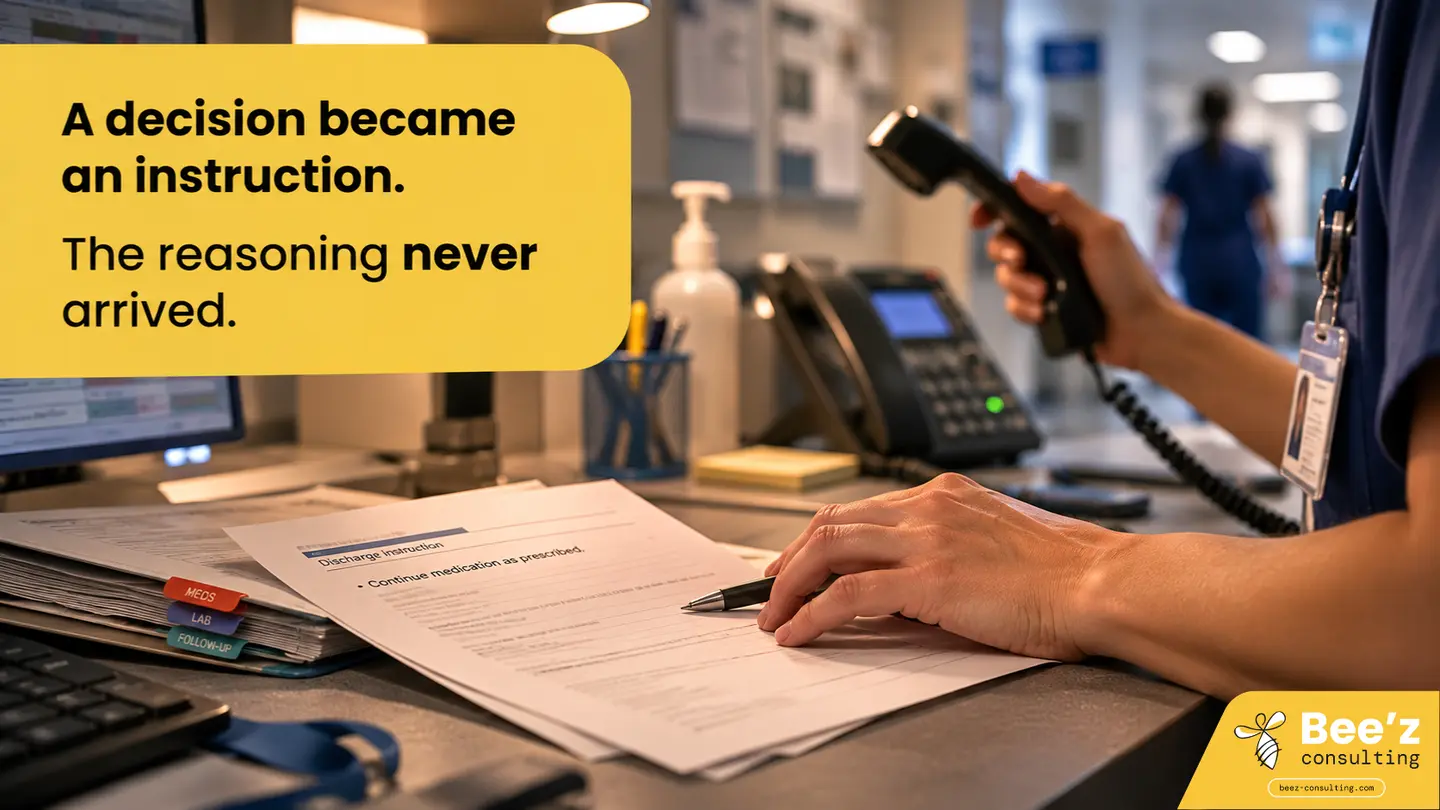
A clinical decision gets made and documented. It reaches the next person in the chain as an instruction with the reasoning removed.
They do the reasonable thing when an instruction doesn't quite fit the situation in front of them: they escalate it, or make their best guess, or wait for someone to clarify. If they escalate, the question lands back on a manager who now spends part of the day re-deciding something that was already decided.
The decision was sound. It just didn't come with enough attached to be acted on by anyone who wasn't in the room.
Now the same shape in a different building.
A launch decision gets made in the regional review. It reaches the affiliate as a plan to execute, not a plan to adapt. The people carrying it never sat in the room where the trade-offs were weighed, so when a local payer moves differently than the model assumed, or a key account behaves in a way the slide did not anticipate, the field team has nothing to reason from. They escalate or they improvise.
The plan didn't fail on its merits. It was handed off without the thinking that would have let anyone bend it to reality.
Both of these look, from a distance, like follow-through problems. Someone didn't execute. But the failure was set earlier, at the moment the decision left its origin with no owner attached, no authority travelling with it, and no form built to carry the reasoning alongside the instruction. This is the same structural pattern behind what actually breaks patient experience, and the cost it imposes on the people absorbing it is what the companion piece on AI clinical documentation makes visible.
This looks different depending on which part of the organisation you run.
If you lead the middle layer, the managers and coordinators and team leads who absorb these handoffs, the pattern you see is chronic escalation. Decisions keep coming back up when they should have been resolved below.
The easy reading is that the managers are not strong enough yet. The more accurate one is that they are holding decisions they were never authorised to complete. That is a question of authority, not capability, and no amount of leadership training closes an authority gap. This is what it looks like when middle managers absorb the cost of decisions the system never finished designing.
If you are the person who signed off on the technology, the COO, the transformation lead, the PMO, the commercial excellence lead, you are watching an investment that isn't returning what the business case promised.
You bought intelligence for the room, or the lab, or the launch. The device shipped. The platform went live. The model runs. And the benefit leaks out in the layer after the decision, because the tool changed and the workflow around it stayed exactly as it was.
The manager living the escalation daily and the executive reviewing the disappointing adoption numbers are looking at one problem from two ends.
This is the same structural dynamic explored in why it's a system problem, not a people problem, and in how accountability needs to be embedded in daily habits rather than announced from the top.
None of this argues for using AI more carefully inside the room. The tools pointed at the decision are worth building. They solve the part of the problem that was already easiest to solve.
The harder and more valuable move is to point that same design attention at everything that happens after the decision is made.
Three things change that:
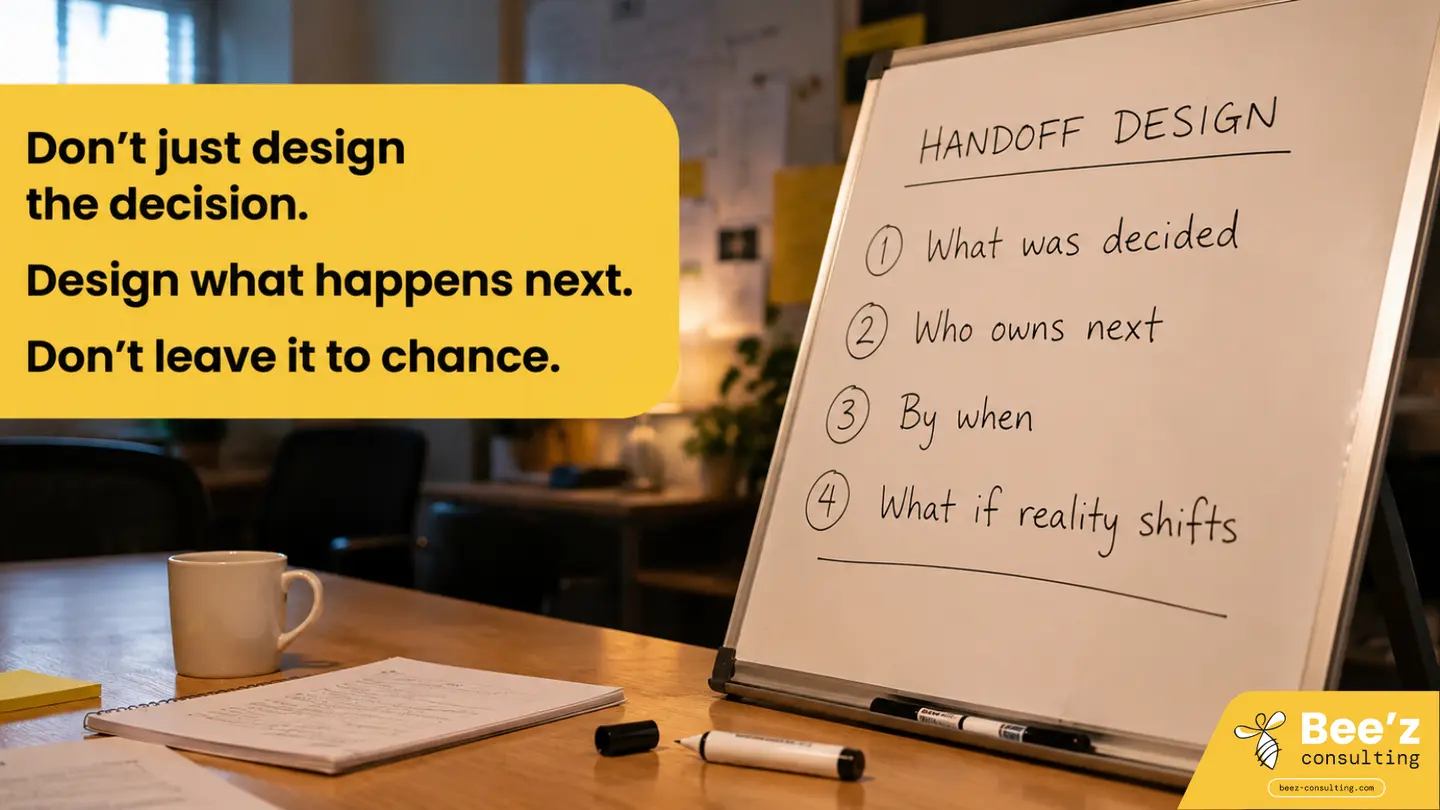
That last part is the one organisations skip, because it feels like overhead in the moment the decision is made and the room is ready to move on.
It stops feeling like overhead about two days later, when the phone rings, or the affiliate calls, or the escalation lands, and someone has to reconstruct from scratch what everyone in the room already knew and nobody wrote down.
The decision was never the hard part. AI is the proof: it made the decision faster and made none of the rest of it easier. The hard part is everything you asked that decision to survive once you stopped watching it. That is the part still waiting to be designed.
Healthcare handoffs break because the decision was never designed to survive the transfer. Three structural reasons drive this: ownership of follow-through is assumed rather than assigned, the people carrying the decision forward lack the authority to act on it, and the decision itself arrives stripped of the reasoning that produced it. The failure is in the design of the handoff, not in the quality of the decision.
A healthcare decision handoff is the moment a clinical or operational decision moves from the person who made it to the person or team responsible for carrying it forward. In practice, it is where context gets lost, ownership becomes ambiguous, and an instruction replaces a decision. Most handoffs are treated as transmission when they are actually translation.
In most healthcare organisations, nobody owns it explicitly. Follow-through is assumed rather than assigned. Nurses, coordinators, and frontline staff inherit the decision without a clear mandate, without the context that produced it, and often without the authority to adapt it when reality doesn't match the plan. The result is that accountability disappears between roles.
Middle managers escalate because they hold decisions they were never authorised to complete. The problem is an authority gap, not a capability gap. When a manager inherits a decision without the standing to adapt it, the only safe option is to send it back up. No amount of leadership training closes a gap that is structural, not personal.
A decision built to travel includes four things: what was decided, who owns what comes next, by when, and what to do when reality doesn't match the plan. This turns the handoff from a moment of transmission into a designed deliverable. It feels like overhead when the decision is made and stops feeling like overhead two days later when the escalation lands.
AI accelerates the decision inside the room. It does not address the structural reasons the decision fails to survive once it leaves. Ownership, authority, and the form of the handoff itself are organisational design problems, not technology problems. The tool changed. The workflow around it stayed exactly as it was.
A decision carries context: the reasoning behind it, the trade-offs considered, the conditions under which it should be adapted. An instruction is a decision stripped to its conclusion. When a clinical decision crosses a handoff, the reasoning stays in the room and the instruction travels alone. The person receiving it has no basis for judgement when reality doesn't match.
The same structure applies. A launch decision made in a regional review reaches the affiliate as a plan to execute, not adapt. The field team never sat where the trade-offs were weighed, so when a local payer or key account behaves differently than the model assumed, they escalate or improvise. The plan didn't fail. It was handed off without the thinking that would let anyone bend it to reality.
Decision ownership means someone is responsible by name for whether a decision held after it left the room, not just for making it in the first place. In most organisations, the decision gets recorded but its downstream life belongs to no one. Assigning ownership of follow-through before the decision leaves the room is the single most underused structural fix.
Because chronic escalation is usually a structural problem, not a capability problem. Managers escalate when they hold decisions they lack the authority to complete. Training improves skills. It does not grant decision rights. Closing the gap requires matching the authority given to middle managers with what the organisation is asking them to carry.
.png)


We train managers alone, then ask them to succeed as a team. What clinical simulation teaches management training, in every sector.
When development, recruitment and performance stop building the capabilities you need, your competency framework may be the cause. Three shifts, one test.
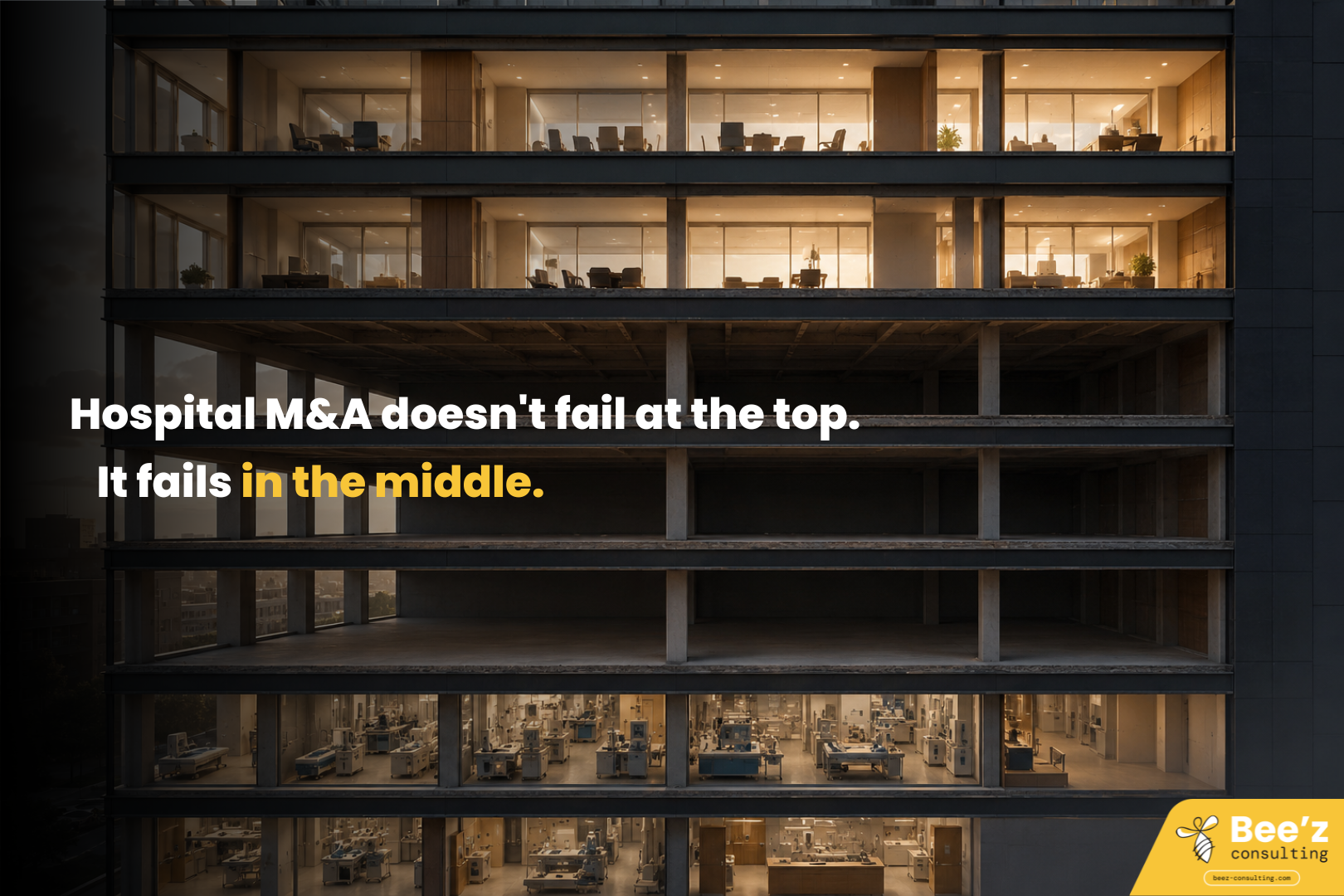
Hospital M&A fails not at the top but in the middle layer. Here is what the governance vacuum looks like and what leaders who see it do differently.

