
.png)
The scene is familiar.
The executive team has just closed a hard strategy cycle. There is a clear slide deck. A strong story for the board. A roadmap that runs until 2027.
You walk out of the room feeling proud. Then a few weeks later you hear the same sentence again.
“We have a solid strategy. Yet change still gets stuck in the middle.”
You are not wrong to look there.
But the problem is not that your middle managers are resistant by nature.
The problem is that we ask them to deliver on strategy without giving them the space, clarity, or support to lead in the way the strategy needs.
Recent research and what we see every week in Swiss and European healthcare tell the same story. When middle managers are set up well, change moves. When they are left alone with the pressure, change stalls.
This article looks at what new studies say about the role of the middle layer, and how you can support your managers in practice.
Not with more decks. With simple weekly habits and real practice labs that fit the reality of clinics, pharma teams, labs, and medtech units.
Most organisations invest a lot of time at the top. Strategy retreats. board packs. complex plans. They also spend more and more on frontline training and tools.
The layer in between often gets the leftovers.
Middle managers sit in an uncomfortable spot. They need to turn strategy and values into daily decisions. They need to keep teams safe, motivated, and on track. They are the first to get questions about change and the first to hear worries about workload, AI, pay, or staffing.(McKinsey & Company)
Yet many of them:
This is not just a feeling. Gallup’s research shows that around 70% of the differences in engagement between teams can be traced back to the manager.(Gallup.com)
When managers are engaged and supported, team performance, retention, and even safety outcomes improve. When they are exhausted or unclear, the cost hits the whole system.
Deloitte points to a similar pattern. Programmes where middle managers play a leading role in the transformation are far more likely to succeed than those driven only from the top.(Deloitte United Kingdom)
In other words. Your middle managers are not a “nice to have” for change. They are the change.
An article in MIT Sloan Management Review, Building Culture From the Middle Out, puts strong words on something many leaders feel. Midlevel leaders are not just delivery channels for culture. They are the ones who actually build it in daily work.(Magzter)
The authors talk about two layers:
Most people live the second one.
The research shows that the best midlevel leaders link both. They take a few key values from the big-C culture and turn them into simple habits inside their teams. They experiment with small routines that make values real. They also learn from other managers and copy good ideas across units.
For example. In a company that says it values equality, a manager invites junior staff into big meetings as active voices, not silent note takers. In a company that values learning, a leader starts each team meeting with “one thing I tried that did not work, and what I learned from it.” Small actions. Big signals.
The message for executives is clear. If you want culture and strategy to feel real, you cannot bypass the middle. You need to support your managers as culture builders, not just message carriers.
Recent work from MIT Sloan and others points to one simple answer for what really lifts team commitment. It is not the bold vision or the glossy deck. It is what team leaders actually do each week with their people.(Magzter)
Three habits stand out. You already named them in your draft. Let’s open them up.
Teams respond when their manager explains, in plain language, what matters and why. Not once a year. Not in a town hall. But in short, two-way conversations.
This looks like:
The magic is in the rhythm. Clarity is not a speech. It is a steady drumbeat. Little, often.
If some people feel backed and others feel ignored, trust drops fast. So does any sense of shared purpose.
Managers who keep trust high tend to:
Gallup’s data keeps showing that people leave managers, not jobs.(Gallup.com) Fairness and steady support matter more to engagement than any perk.
People lean in when they can take decisions without fear of being corrected later. Autonomy sends a simple message. “I trust you.”
For a nurse unit manager, this might be allowing the team to adjust shift huddles.
For a lab team lead, it might mean deciding how to role split between analysis and admin.
For a regional pharma manager, it could be choosing which clients to visit in person and which to handle online.
The point is not chaos. The point is to define clear guardrails, then give managers and their teams room inside them.
When these three habits appear together. Clear direction, fair relationships, and real room to act. Commitment rises. With it come better performance, problem solving, and lower turnover.
In Swiss and European healthcare, life sciences, and medtech, the stakes are even higher.
Middle managers carry the weight of:
Ward managers, department heads, lab supervisors, trial leaders, engineering and quality leads. They all sit between policy and reality.
They are the ones who have to say:
But many of them lack:
The result is a silent tax on your strategy. A slow erosion of trust. More issues escalated “upwards” that could be solved closer to the work.
The cost of under-supporting managers shows up everywhere.
Recent global data points to a drop in manager engagement and a big hit on productivity. One study estimated hundreds of billions in lost value as manager engagement declined between 2023 and 2024.(Business Insider)
When middle managers are drained and unclear, you see:
In healthcare, this is not just a P&L issue. It touches safety, outcomes, and trust from regulators, payers, and the public.
For leaders, the choice is simple. You can keep accepting this hidden cost. Or you can treat middle managers as one of the strongest levers you have for healthy performance.
So what does real support look like? The research and our work on the ground point to a clear pattern.
At Bee’z Consulting, supporting this middle layer is one of the main ways we help clients move from plans to action.
In our work with clinics, pharma teams, labs, and medtech units, we help middle managers to:
We do this through simulations and practice labs, where managers work on real-life cases in a safe space. They can test choices, see the impact on staff and patients, and adjust. All of this happens before they apply it “on the floor”.
Typical elements include:
We do this on real cases, in their own context, and often in their own language. English, French, Spanish, and sometimes German.
The result is not another slide deck. It is day-to-day behaviour change.
Let’s take a composite example, based on several clients in our healthcare work.
A clinic group wanted to improve patient experience scores and reduce delays in discharge. The strategy was clear. Posters, dashboards, and a strong message from the CEO.
Yet after six months, scores had barely moved. Middle managers reported “change fatigue”. Staff felt that “nobody listens” and “everything is urgent”.
Together we shifted the focus from a general campaign to middle-manager practice labs:
Within three months, leaders started to see:
The strategy did not change. The slide deck did not change. What changed was the behaviour of the people in the middle.
You do not need a huge programme to start. Here are five moves you can launch in the next three months.
As AI, new regulations, and workforce shortages reshape healthcare and life sciences, the role of the middle manager will only grow.
They will be the ones who:
Some organisations are cutting layers of management in the name of efficiency. Others are moving in the opposite direction and investing in this layer as a core asset. Early signs suggest the second path is the safer bet.
If your strategy feels solid but results stay stuck in the middle, this is not a character flaw in your managers. It is a design issue.
The research is clear. Middle managers explain a large part of your engagement, culture, and transformation success.(McKinsey & Company)
Our work in Swiss and European healthcare, life sciences, and medtech shows that when you give them:
…they stop acting as “traffic controllers” and start acting as the steady link between strategy and action.
If this sounds close to what you are facing right now, we would be glad to speak.
We can share how other leaders have approached this, what they learned along the way, and what a focused middle-manager journey could look like in your context.
👉 Want your middle managers to be the strongest part of your change. Not the weak link? Let’s talk : https://www.beez-consulting.com/contact
1. Why focus on middle managers instead of senior leaders?
You need both. Senior leaders set direction and constraints. Middle managers turn that direction into daily decisions, habits, and conversations. Without them, strategy stays on slides.
2. How do we measure the impact of investing in middle managers?
Look at engagement, retention, patient or customer experience, and speed of decisions before and after a focused programme. Many studies link strong middle management to better financial and cultural outcomes.(McKinsey & Company)
3. We are short on time. How can managers fit this in?
Good design gives time back. For example, a 15-minute daily huddle that prevents one hour of firefighting later. Or a clear decision rule that removes endless email loops.
4. Is this only relevant for hospitals and clinics?
No. The same logic applies in pharma, medtech, biotech, diagnostics, and beyond. Any place where complex work needs coordination and trust across teams will benefit.
5. Can this work across languages and cultures?
Yes. The principles are simple. Clear direction, fair relationships, and room to act. The examples, language, and cases should reflect your context. This is why we work in several languages and adapt cases to each client’s reality.
.png)

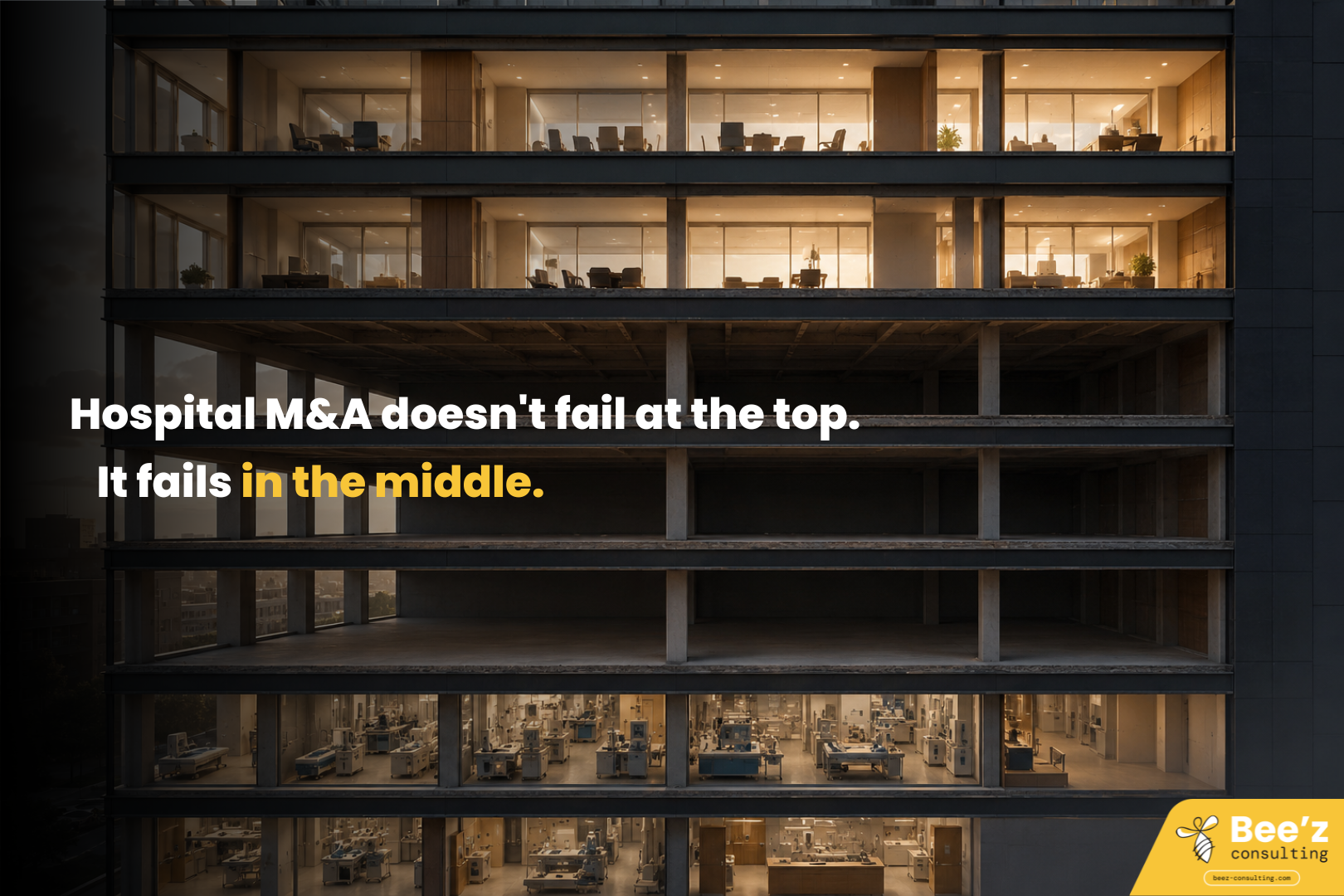
Hospital M&A fails not at the top but in the middle layer. Here is what the governance vacuum looks like and what leaders who see it do differently.
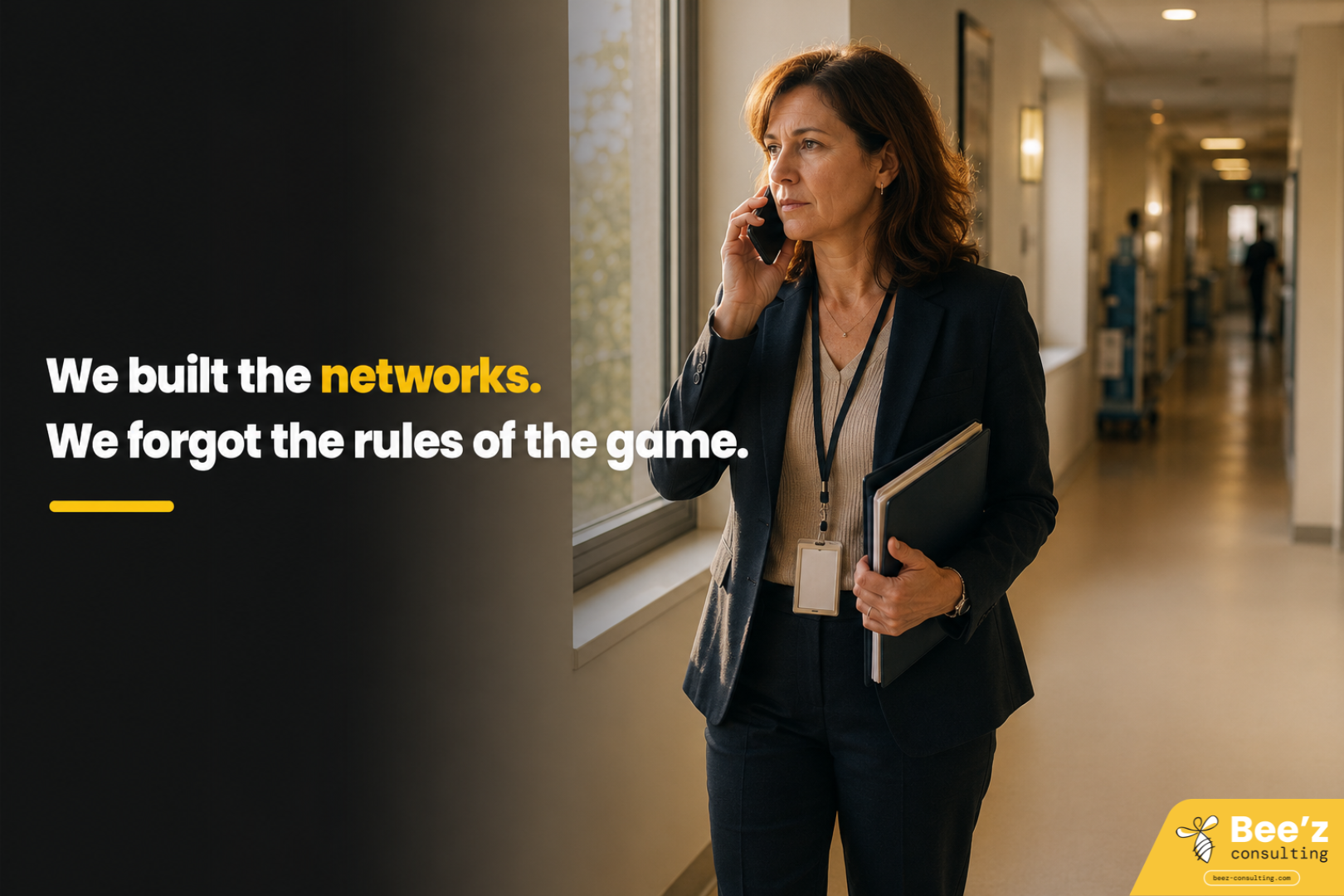
Across Europe, care is moving out of hospitals. What will determine whether it works: the operating rules inside networks, and preparing the people who run them. 3 operational keys.

Healthcare handoffs break for three structural reasons. Ownership stops at the door. Authority never travels. The decision was never built to survive.

