

Clinical credibility matters. But it cannot replace the time, authority, clarity and support clinical leaders need to turn change into better care.
The healthcare transformation is approved.
The case is strong. The timeline is clear.
The executive team agrees on the outcome.
Then people go back to work.
A nurse asks how the new process will work during a busy shift. A doctor wants to know when clinical judgment can override it. Operations needs to know what will happen to staffing and patient flow. The team asks what it should stop doing to make room for the new work.
The strategy may have been agreed at the top. But these questions do not stay there.
They land with department heads, medical directors, service leads, nurse managers and other clinical middle managers, not as a support layer, but as the execution layer.
These leaders are expected to make the change work without weakening care.
They must explain it, adapt it, deal with concerns, settle trade-offs and gain support from colleagues whose trust comes from clinical credibility, not job title.
That is why healthcare transformation does not move directly from the executive team to the frontline.
It passes through the clinical middle.
And that is often where the plan meets a role that was never designed to carry it.
Deloitte's recent article, Physician leaders are positioned to shape the Future of Health, makes two important points.
First, physicians can bring clinical credibility, peer trust and direct knowledge of patient care to leadership.
Their role now reaches well beyond medical decisions.
Physician leaders may be asked to guide new technology, improve processes and support change across a whole organisation, alongside their clinical duties.
Second, clinical excellence does not automatically prepare someone to lead.
Physicians may need planned support in communication, self-awareness, influence, collaboration and change management.
The evidence should be treated with care. A 2024 review cited by Deloitte compared healthcare organisations led by people with and without medical backgrounds.
It included eight studies. Four reported better overall results under medically trained leaders, one reported poorer results, and the others found mixed results across measures, especially financial ones.
This points to possible links, not proof that putting a physician in charge causes better performance.
Clinical credibility can help a leader be heard.
It does not make decision rights clear.
It does not create time.
It does not align competing measures.
It does not fix a weak partnership between clinical and operational leaders.
That brings us to the missing question.
It is not only: Is this physician ready to lead?
It is also: Has the organisation made it possible for this physician to lead?
The same question applies to nurse managers and other clinical leaders.
Consider a medical director asked to lead the use of a new digital tool across a service.
She is accountable for adoption.
Her clinical workload is unchanged.
It is not clear whether she can alter team routines.
Technology owns the system.
Operations owns the schedule. Finance tracks cost. Quality watches safety.
Everyone expects progress.
No one has said who decides when those needs conflict.
If adoption is slow, the story may soon become that clinicians are resistant or that the medical director lacks influence.
But look at the role she was given.
Responsibility was added. Time was not.
Accountability was named. Authority was not.
Several functions were involved. The partnership between them was not built.
This is where leadership advice can become unfair. A capable clinical leader will still struggle when:
Under these conditions, delay is not good evidence of weak commitment.
It may show that the organisation has placed the work in the middle without moving the means to do it.
The clinical leader who keeps asking practical questions may not be blocking change. They may be the first person testing whether the plan can survive contact with care.

Calling this layer an implementation channel makes the work sound simple. It is not.
Clinical middle managers interpret broad aims and turn them into hundreds of daily choices.
"Improve access" may mean changing referral rules, clinic templates, staffing patterns or how urgent cases are judged.
"Improve patient flow" may affect discharge decisions, bed use, handovers and work across several services.
"Use the new system" may change who enters information, what happens when a prompt conflicts with clinical judgment and how exceptions are recorded.
This is not delivery by instruction. It is judgment under pressure.
Clinical middle managers also shape whether people believe the change is safe and worth supporting. Staff watch what happens when the programme creates a problem.
Can their manager make a decision?
Will they protect care quality?
Can they explain which part is fixed and why?
Will they raise a concern without blaming the team?
This layer therefore moves information in two directions.
It carries strategy towards the frontline. It also carries reality back towards senior leaders.
When that flow works, problems are seen early.
When it does not, local friction stays hidden until it appears as missed targets, workarounds, staff frustration or harm to patient experience.
The clinical middle is not just a route for change. It is one of the organisation's main sensing networks.
This pattern is visible across Swiss hospitals, European health systems and beyond. Wherever hospital transformation depends on clinical leaders to carry change, the same structural questions apply.
Leadership skills matter. But they cannot make up for a role that lacks time, authority or support.
Before asking clinical leaders to carry a transformation, executive teams should put five conditions in place.
A project name and delivery date are not enough. Clinical leaders need to know what must improve, for whom and why.
Take a new discharge process. Is the main aim to reduce avoidable delay, help patients understand what happens next, free beds earlier or reduce readmissions?
These aims may support one another. Under pressure, they can also compete.
A clear outcome gives local leaders a basis for judgment when the plan does not cover the patient or situation in front of them.
Clinical middle managers need to know what they can decide, what must remain fixed and when an issue should move to a higher level.
They may be able to change a team routine, assign local roles or test how a patient conversation is handled. They may not be able to change a safety rule, legal requirement or shared data standard.
This is not full local freedom. It is enough clarity for action.
When the boundary is vague, managers either wait for approval or make changes that later have to be reversed. Both slow the work.
Leadership work is work. It cannot remain a hidden task done between clinics, after a shift or during personal time.
Protected hours mean little if the clinical load simply moves to evenings or colleagues.
Capacity may require fewer sessions, shared clinical cover, practical project support or the removal of another initiative.
The useful question is not, "How much leadership time is in the job description?"
It is, "What have we removed so this person can use it?"
Healthcare transformation should not become a contest between clinical judgment and management needs.
The clinical leader sees care risks, professional concerns and effects on patients.
The operational partner sees staffing limits, process links, access needs, data and cost. Neither view is complete alone.
The partnership works when both leaders share the same outcome, review the same facts and know how trade-offs will be settled.
It fails when one person is told to "get the clinicians on board" while the other controls the resources and process choices.
Quality, patient experience, workforce, access and cost are not separate conversations. They meet in the same decisions.
No central plan can predict every detail of care.
Teams need room to test how a change works, learn from staff and patients, and adjust within clear limits.
But every service cannot build its own version. That can create new safety risks, data gaps and friction at handovers.
The answer is a short learning cycle: test a defined change, review what happened, keep what works, raise what needs a wider decision and share the learning.
Adaptation then becomes part of the programme, not a quiet workaround.
Formal training can give clinical leaders useful language, tools and time to reflect.
It cannot settle a live conflict over staffing. It cannot clarify who can change a process. It cannot repair a clinical and operational partnership that has never been built.
Development works best when it happens through the change the leader is already carrying.
That can include:
For example, a nurse manager changing a handover routine could map who is affected, agree the fixed safety needs with quality, plan a short test with the operational lead and prepare the conversation with the team.
After the test, the group reviews what staff and patients experienced and decides what to change next.
That is leadership development tied to real work.
The test is not whether the leader completed a course.
It is whether they can now make a clearer decision, hold a harder conversation and help the team work differently.
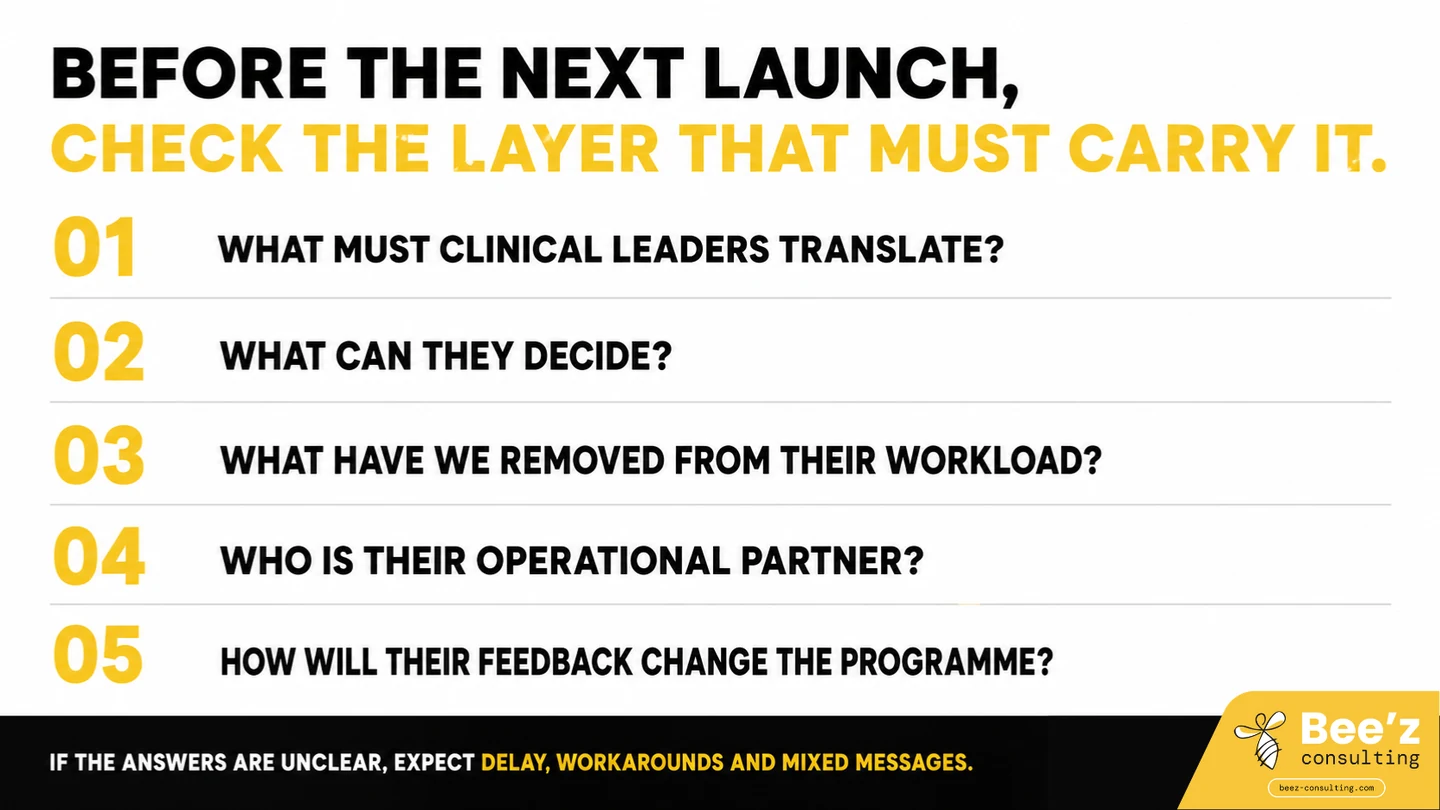
Before approving the next care model, digital rollout or quality programme, the executive team should ask:
1. What do we need clinical leaders to translate?
Is the outcome clear enough to guide local judgment?
2. What can they decide?
Do they know what they can adapt, what is fixed and when to escalate?
3. What have we removed from their workload?
Is there real capacity, or has responsibility simply been added?
4. Who is their operational partner?
Is someone jointly accountable for linking care quality, people, process, access and cost?
5. How will their feedback change the programme?
Is there a route from local learning to a decision, or are leaders only expected to report progress?
If these questions are hard to answer, the issue will not be solved by asking clinical managers to show more commitment.
Healthcare needs capable clinical leaders. It needs physicians, nurses and other professionals who can influence peers, work across boundaries and guide change under pressure.
But capability is only half of the answer.
The organisation must give those leaders time to lead, room to decide, clear expectations, strong partners and a real voice in how the change develops.
Before launching the next transformation, ask one more question:
Have we prepared the clinical middle to carry it?
The clinical middle is the layer of leaders between the executive team and the frontline: department heads, medical directors, nurse managers, service leads. They do not simply pass instructions down. They interpret strategy, adapt it to local care realities, settle trade-offs, and decide what change looks like in practice. When this layer is unsupported, transformation slows, not because people resist, but because the role was never designed to carry it.
Strategy is agreed at the top. But the questions that determine whether it works land with clinical middle managers: how will this affect a busy shift, who decides when clinical judgment and process conflict, what should we stop doing. When those managers lack time, authority, or clarity about what they can decide, the work stalls. The delay is not resistance. It is an organisational design problem.
Clinical credibility means peers trust your medical or nursing judgment. Leadership capability means you can make decisions across functions, hold difficult conversations, align competing priorities, and guide a team through change. The first earns you a hearing. The second requires time, authority, clear expectations, and an operational partner. Organisations that confuse the two promote excellent clinicians into roles that have not been built to succeed.
Training gives clinical leaders useful language and tools. It cannot settle a live staffing conflict, clarify who can change a process, or build a clinical-operational partnership that has never existed. Development works best when it happens through the change the leader is already carrying: working on a real issue, getting feedback on a real conversation, testing a real adjustment with their team.
It is the working relationship between a clinical leader (who sees care risks, professional concerns, and effects on patients) and an operational partner (who sees staffing limits, process links, access needs, and cost). Neither view is complete alone. The partnership works when both share the same outcome and know how trade-offs will be settled. It fails when one person is told to "get clinicians on board" while the other controls the resources.
Start with five questions before the next launch. What do we need clinical leaders to translate? Can they actually decide anything, or must they wait for approval? What have we removed from their workload so they have real capacity? Who is their operational partner? And how will their feedback change the programme, or are they only expected to report progress? If these questions are hard to answer, the issue is structural, not motivational.
Clinical middle managers are one of the organisation's main sensing networks. They move information in two directions: carrying strategy towards the frontline and carrying reality back towards senior leaders. When that flow works, problems surface early. When it breaks, local friction stays hidden until it appears as missed targets, workarounds, staff frustration, or harm to patient experience.
Evidence suggests possible links, not proof of cause. A 2024 scoping review found that four of eight studies reported better overall results under medically trained leaders, one reported poorer results, and the rest were mixed. Clinical credibility helps a leader be heard. But it does not make decision rights clear, create capacity for leadership work, or build the cross-functional partnerships that transformation requires.
Middle management activation means moving managers from overwhelmed coordinators into leaders who create ownership, accountability, and results. It requires the organisation to do its part: clarifying what managers can decide, protecting real time for leadership work, building clinical-operational partnerships, and creating feedback loops where local learning changes the programme. Activation is not a training intervention. It is a role-design commitment.
Deloitte, Physician leaders are positioned to shape the Future of Health, 7 July 2026
Mohmad, S., Lee, K. Y. and Bakit, P., Do health-care institutions perform better under leaders with medical or non-medical backgrounds? A scoping review, Leadership in Health Services, 2024
.png)


We train managers alone, then ask them to succeed as a team. What clinical simulation teaches management training, in every sector.

When development, recruitment and performance stop building the capabilities you need, your competency framework may be the cause. Three shifts, one test.

Hospital M&A fails not at the top but in the middle layer. Here is what the governance vacuum looks like and what leaders who see it do differently.

