

In April 2026, MSC, the world's largest container shipping company, agreed to acquire Hirslanden, Switzerland's largest private hospital group. Sixteen clinics. Thirteen thousand employees. $1.08 billion.
The internal communication to doctors and staff read: "For the time being, nothing will change."
That sentence is written for people who experience the acquisition as an announcement.
Most of the organisation experiences it as something else entirely.
A few weeks ago, we wrote about ambulatory transformation: what it takes for a hospital to operate beyond its walls, with partners it didn't choose, inside a model nobody fully designed. The question at the centre of that piece was governance: who decides, when the old logic no longer holds.
That governance question doesn't only surface when a hospital expands beyond its walls. It also surfaces when the walls change ownership.
The handover, and what happens when it breaks: Why Healthcare Handoffs Break
What gets reported is the number.
$1.08 billion. The strategic rationale. MSC diversifying beyond shipping. Mediclinic Group restructured along geographic lines, Remgro taking South Africa, MSC taking Switzerland. Clean. Decisive. Done.
The integration looks managed because the parts that are visible are managed.
Most of the organisation experiences it as something else entirely.
Here is what the integration plan doesn't name.
Hirslanden has operated inside Mediclinic's governance culture for nearly twenty years. A South African-rooted, internationally listed healthcare group with its own performance logic, its own escalation norms, its own definition of what a well-run clinic looks like. That logic was never written down in a manual. It didn't need to be. Everyone already knew it.
That logic is now dissolving.
In its place: a new ownership structure nobody in the clinics has a reference point for. MSC is a privately held family empire. Its instincts around performance, accountability, decision speed, and risk are entirely its own. In most integrations of this scale, translating that logic into what it means for daily operational decisions takes longer than the announcement suggests.
The ward coordinator approving weekend staffing in Lausanne has one question: what does any of this mean for how I work on Monday? Integration roadmaps don't answer that question. Someone has to.
Mediclinic Group still exists as a governance layer. The people now leading it bring a different background from the culture that shaped Hirslanden over twenty years. That distance is not a problem in itself. But it is real, and it lives inside the governance structure sitting above Hirslanden's executive team.
And above all of it: an owner whose core business is moving containers across oceans.
In most integrations of this kind, that translation, if it comes, rarely reaches the operational level at the speed the organisation needs it. The cultural work lands wherever nobody has done it.
Switzerland recorded 29 hospital and care home M&A transactions in 2025, up from 23 the year before.
In France, four groups already control 40% of private hospital capacity: Ramsay Santé, Elsan, Vivalto, Amalviva. Ramsay Santé is itself in ownership transition; its Australian parent is seeking to exit, with a shareholder vote expected before the end of 2026. Clinic directors across France are living the same question Hirslanden's regional managers are living: who is the real owner now, what do they actually want, and how do we decide when the governance frame is shifting beneath us?
This is the condition of the sector.
Two-thirds of Swiss hospitals reported a worsening financial position in 2025, with cumulative losses across deficit-running facilities reaching CHF 750 million (SWI swissinfo.ch, November 2025). In France, according to the Fédération de l'hospitalisation privée, 46% of private clinics operated at a deficit in 2025, up from 26% in 2021 (FHP / Roland Berger, April 2026).
The financial pressure is real on both sides of the border. And it is that pressure, more than anything else, that is driving the consolidation wave.
The ownership change is the headline. The governance vacuum is what the organisation actually has to live in.
The directives still come from Zurich. The reporting lines still exist. The memos carry the same signatures.
But the logic that used to give those directives meaning: the Mediclinic governance culture, the performance priorities of the previous ownership, the strategic frame that told a regional director which decisions were hers and which needed to go up — that logic is being replaced by something nobody has seen yet.
So when a conflict arises between a clinical priority and a financial one, between what the old culture would have decided and what the new owner might want, there is no compass.
A clinic director escalates. Zurich is also figuring it out. The answer takes longer. Or it arrives, but without the reasoning. She executes it without understanding the logic behind it. Next time a similar conflict arises, she is no more equipped than she was before.
This lands on people who were already stretched. Swiss hospitals are fighting for every nurse they can find. 100% of hospital organisations surveyed by KPMG confirmed a shortage of qualified staff, with nursing the most acute gap. Nearly one in five registered nurses in Switzerland doesn't intend to stay in the profession (SCOHPICA cohort study, Swiss universities). The governance vacuum of an integration doesn't arrive into a system with slack. It arrives into one that was already at the limit.
What keeps people, beyond pay and working hours, is a sense that their judgment is valued and their environment is navigable.
A governance vacuum quietly removes the second of those. Without anyone announcing it.
The orders still come from Zurich. The frame that makes those orders navigable might take more time to get there.
This is what gets misread as slow adoption, or cautious management, or resistance to change.
It is none of those things. It is an organisation operating without a governance compass — waiting for someone to give it one.
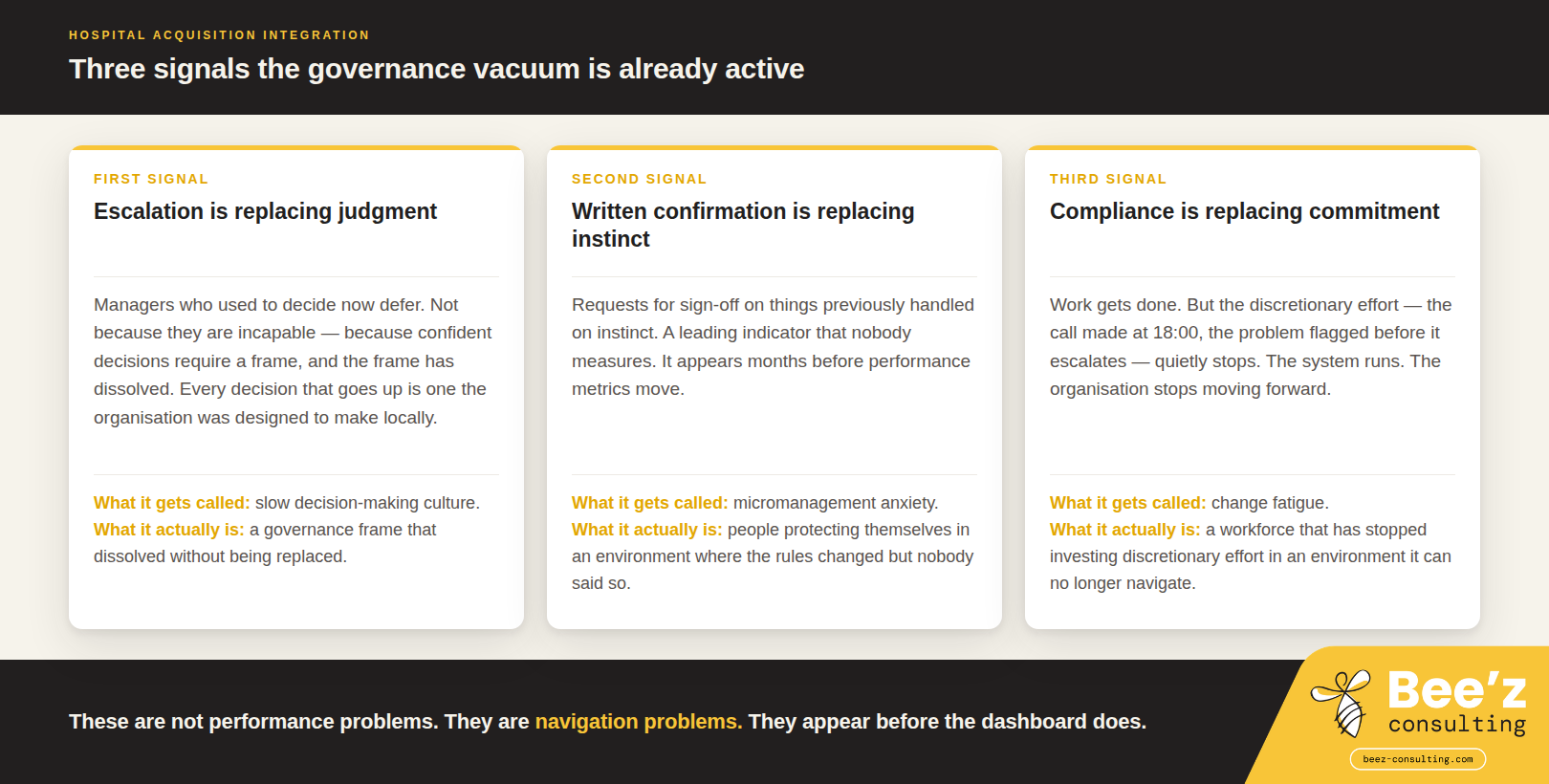
The breakdown is not dramatic. It is slow and invisible until it isn't.
Decision routing becomes uncertain. People don't know which priorities govern which trade-offs. They don't know what the new owner actually cares about: cost efficiency, clinical excellence, growth, something else entirely. So they default to what they know — the old logic, or pure caution.
Regional managers stop making the discretionary calls they used to make confidently. Not because they are incapable. Because confident discretion requires a frame, and the frame is gone.
Escalation increases. But the escalation path leads to a governance layer that is itself in transition: a Mediclinic group leadership navigating between a new Swiss public healthcare instinct and the expectations of an owner that has never run hospitals before.
The operational phase of the integration arrives — new reporting expectations, new performance metrics, new strategic priorities — just as the regional layer has hit the limit of what it can absorb without clarity.
Judgment withdrawal looks like resistance. It isn't.
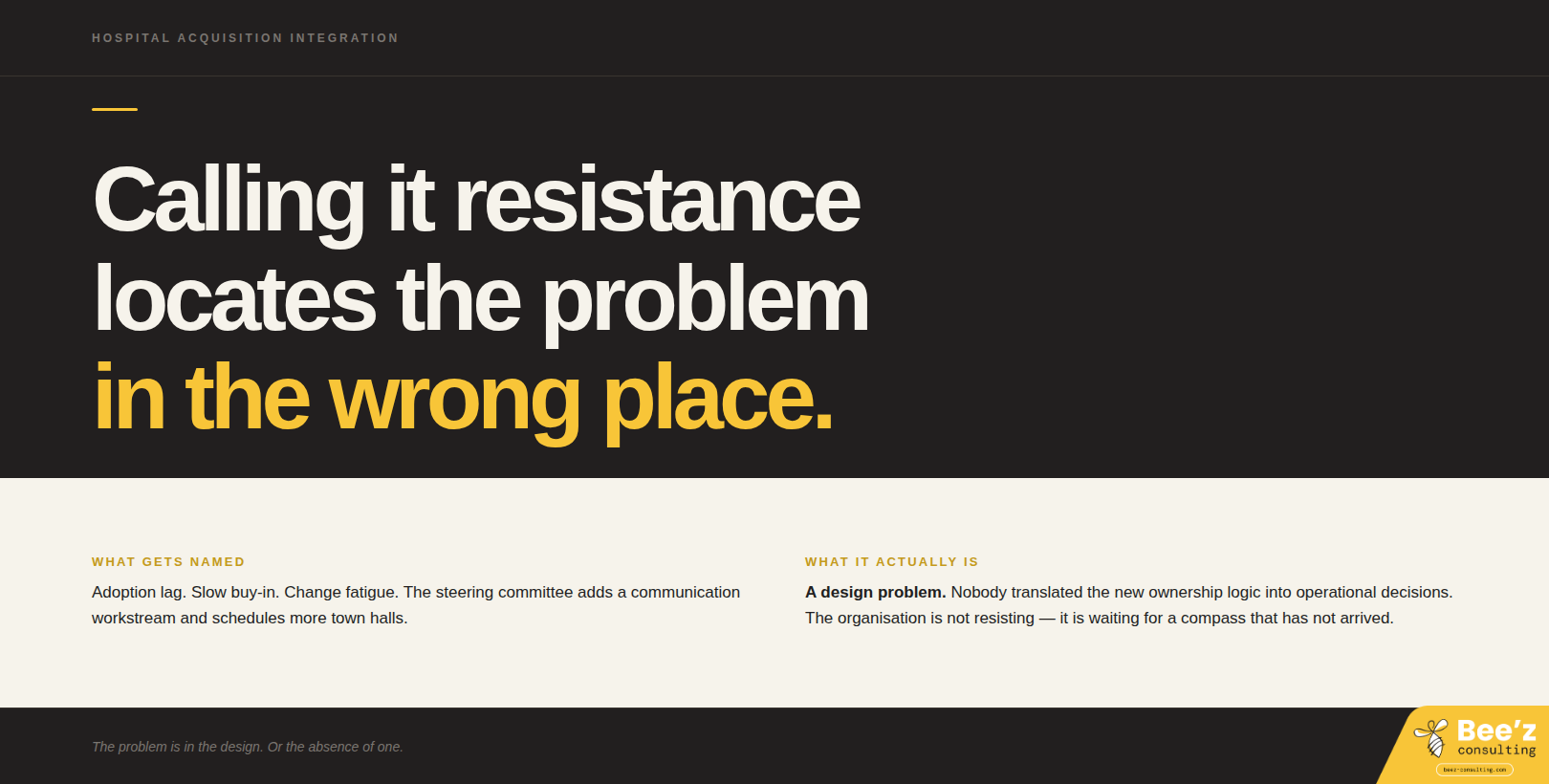
The steering committee sees adoption lag.
HR recommends a communication programme. Town halls are scheduled. A video message from leadership is recorded and sent.
None of that is wrong. Communication matters.
But communication fills a gap. It does not replace a compass.
What the organisation is actually missing is not information about the new direction. It is the translated logic that makes the new direction navigable at the level where operational decisions are made every day.
The difference matters because the responses are completely different.
Adoption lag is solved by better communication and clearer expectations. A governance vacuum is solved by translating ownership logic into operational reality: making explicit what was previously implicit, naming who decides what under which conditions, and giving regional and clinical leaders a frame they can actually use.
Calling it resistance locates the problem in people. The problem is in the design — or the absence of one.
Not a methodology. Three things that require a different quality of attention.
They distinguish between the announcement and the translation.
An acquisition announcement tells people what has happened. It does not tell them what it means for how they work tomorrow. The leader who sees this understands that the communication plan and the translation work are not the same thing. The second one is harder, slower, and cannot be delegated to a town hall.
Translation means making explicit what the new ownership logic actually implies for daily operational decisions. What does performance mean to this owner? What gets prioritised when clinical and financial objectives conflict? What decisions can regional management make autonomously, and what needs to go up — and to whom, in a governance structure that is itself being rebuilt?
They go looking for the compass problems before the organisation stops moving.
The signal is not resistance. It is the accumulation of small deferrals: decisions that used to be made at one level now being escalated, calls that used to be returned quickly now taking days, managers who used to act with confidence now asking for written confirmation of things they previously handled on instinct.
These are not performance problems. They are navigation problems. A leader who reads them correctly intervenes before they become structural.
They connect what is happening now to what was already in motion.
Hirslanden's regional leaders were already navigating the shift to ambulatory care: new coordination models, new relationships with partners outside the hospital walls, new decision rights that nobody had fully designed. That transformation was already asking them to operate with less certainty than before.
The ownership change arrived on top of it.
The middle layer is not navigating one governance question. It is navigating two simultaneously. The organisations that see both are the ones that can actually help.
Most integration post-mortems look at the top.
The governance decisions that were slow. The executive alignment that turned out to be partial. The synergies that didn't materialise at the pace the model predicted.
That audit has its uses.
The more useful one looks one layer down. It asks what the regional and operational layers were asked to absorb without a translated frame. Which decisions became impossible to make confidently. Where escalation replaced judgment. How long the organisation operated without a compass before anyone named it.
That audit is harder to run. The data doesn't sit in a dashboard.
It sits in the people who kept the clinics running while the integration was being managed above them.
Healthcare consolidation is accelerating across Switzerland, France, and the wider European market. Hirslanden won't be the last. If your organisation is in the middle of this, or about to be, the conversation is worth having before the problem becomes visible in your results.
→ On the same theme: what ambulatory transformation actually requires and why the governance question is the same one. Ambulatory Care Transformation: What Will Make It Work
A governance vacuum occurs when the decision-making logic of the previous owner dissolves before the new owner's logic has been translated into operational terms.
Directives keep arriving. But the frame that gave them meaning has disappeared.
Front-line managers no longer know which priorities govern which trade-offs, or who to escalate to when the two conflict.
Senior leadership negotiates, decides, and announces. They have direct access to the new owner's logic.
The middle layer must translate that logic into daily operational decisions — without an explicit mandate, without the authority to resolve contradictions, and without having been prepared to do so.
That is where the integration lives or dies. Management systems don't see it because the data isn't there.
Adoption lag shows up as a lack of information or conviction. The response: better communication, clearer expectations.
A governance vacuum shows up differently.
- Decisions escalating where they used to be resolved lower down.
- Managers seeking written confirmation for things they previously handled on instinct.
- Escalation accumulating toward a governance layer that is itself searching for its bearings.
Conflating the two means responding to the wrong problem — and making both worse at the same time.
Every owner has their own priorities: what defines performance, how conflicts between clinical and financial objectives get resolved, what decision-making latitude remains at the regional level.
That logic is rarely written down. In a stable organisation, it doesn't need to be — everyone already knows it.
In an ownership change, the previous owner's logic dissolves before the new owner's is available. Translation is the work that fills that interval: making explicit what was implicit, so decisions can continue to be made at the right level.
Three signals to watch.
- Escalation rising without clearer resolutions coming back: questions go up, but answers are slow or arrive without reasoning.
- Managers stopping the discretionary decisions they previously owned, seeking formal validation instead.
- Delays appearing in areas that were previously functioning: scheduling, protocols, cross-team arbitration.
These signals always precede visible problems in results. By the time they show up in data, the vacuum has been active for weeks.
The MSC acquisition of Hirslanden illustrates a configuration found in any large-scale ownership change: a hospital group anchored in a specific governance culture for decades, passing to an owner whose core business is entirely different.
The question isn't whether MSC is a good or bad owner. The question is how long it will take before their logic is translated into operational terms for the 13,000 people who work in the clinics.
That translation lag is what integration models consistently underestimate.
Consolidation is accelerating under financial pressure: two-thirds of Swiss hospitals running deficits in 2025, 46% of French private clinics in the red.
Every transaction produces a governance interval: the old logic no longer applies, the new one isn't yet translated. That interval rarely lasts a few weeks. It often lasts several months.
Multiplied by the current pace of consolidation, this risk is no longer a one-off event. It is a structural condition of the sector.
Both transformations pose the same fundamental question: who decides, when the usual frame of reference no longer holds?
In ambulatory transformation, teams must coordinate with external partners on pathways nobody fully designed. In an ownership change, they must decide according to a logic nobody has yet translated.
For Hirslanden's regional leaders, both are accumulating simultaneously. That is not a coincidence: it is the condition of most European hospital organisations right now.
On what ambulatory transformation actually requires: Ambulatory Care Transformation: What Will Make It Work
Most post-integration audits examine decisions made at the top: pace of leadership alignment, synergy realisation, communication consistency.
The audit that produces the most value looks one layer lower. It asks four questions.
- What decisions was the regional layer asked to make without a translated frame?
- Where did escalation replace judgment, and for how long?
- Which contradictions between the two organisational cultures were absorbed without being named?
- How long did the organisation operate without a compass before anyone named it?
The answers aren't in dashboards. They are in the people who kept the clinics running while the integration was being managed above them.
Bee'z works with organisations at the exact moment the integration's complexity arrives at the operational level — when directives exist but the logic that gave them meaning is in transition.
The work focuses on three areas.
- Translating the new owner's logic into an operational frame that regional and clinical management can actually use.
- Identifying the zones where judgment withdrawal has already begun, before it becomes visible in results.
- Giving middle-layer leaders the tools to decide with confidence inside a frame that is being rebuilt.
Consolidation is accelerating. Hirslanden won't be the last. The conversation is worth having before the problem becomes visible in your results.
.png)


When development, recruitment and performance stop building the capabilities you need, your competency framework may be the cause. Three shifts, one test.
Hospital M&A fails not at the top but in the middle layer. Here is what the governance vacuum looks like and what leaders who see it do differently.

Across Europe, care is moving out of hospitals. What will determine whether it works: the operating rules inside networks, and preparing the people who run them. 3 operational keys.

