
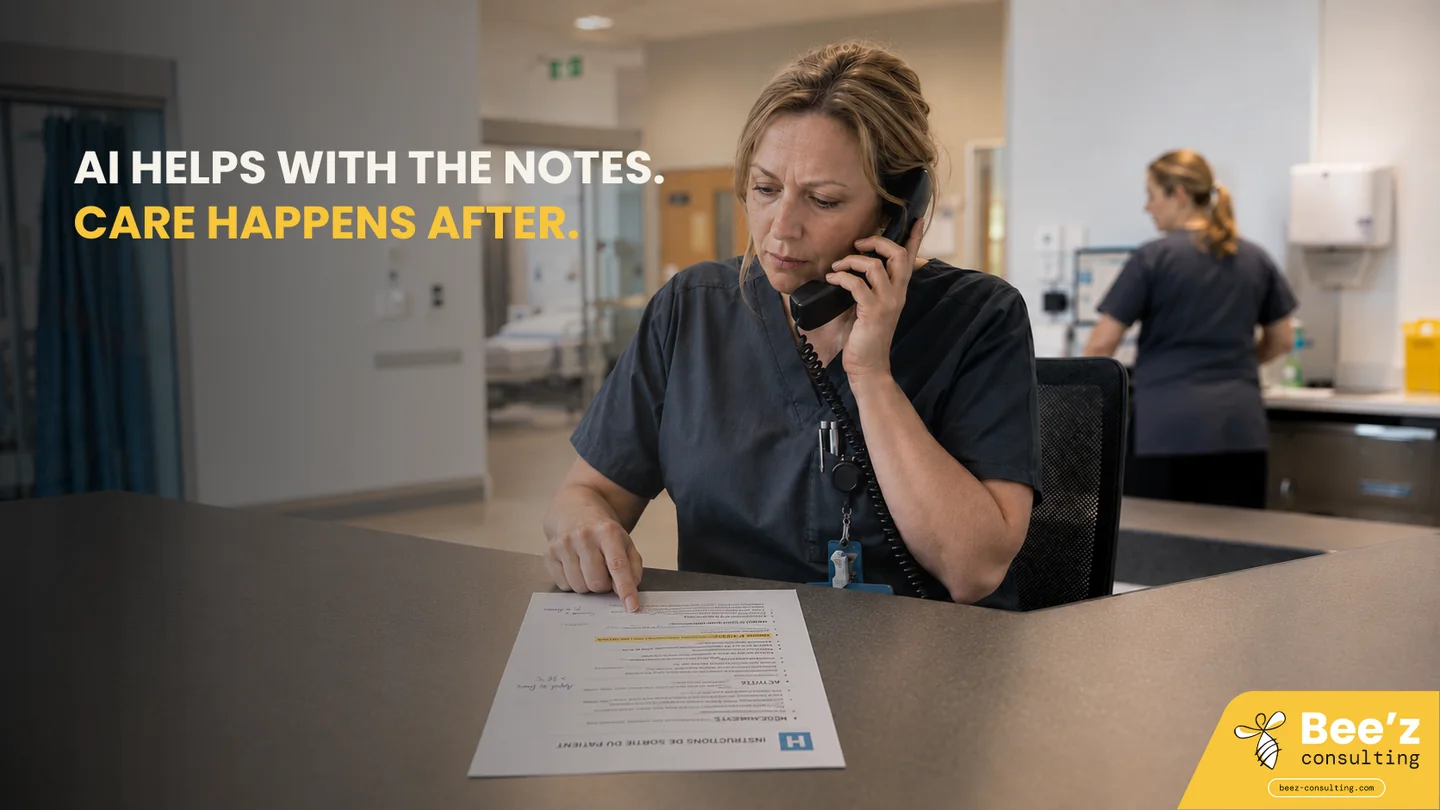
AI finishes the note in seconds. The care that note is supposed to trigger still depends on a handoff nobody designed.
AI clinical documentation is supposed to be making healthcare smarter. Faster notes, sharper decisions, less time lost to admin. Walk into most hospital innovation conversations right now and you'll hear some version of the same pitch: give clinicians better tools in the room, and care gets better.
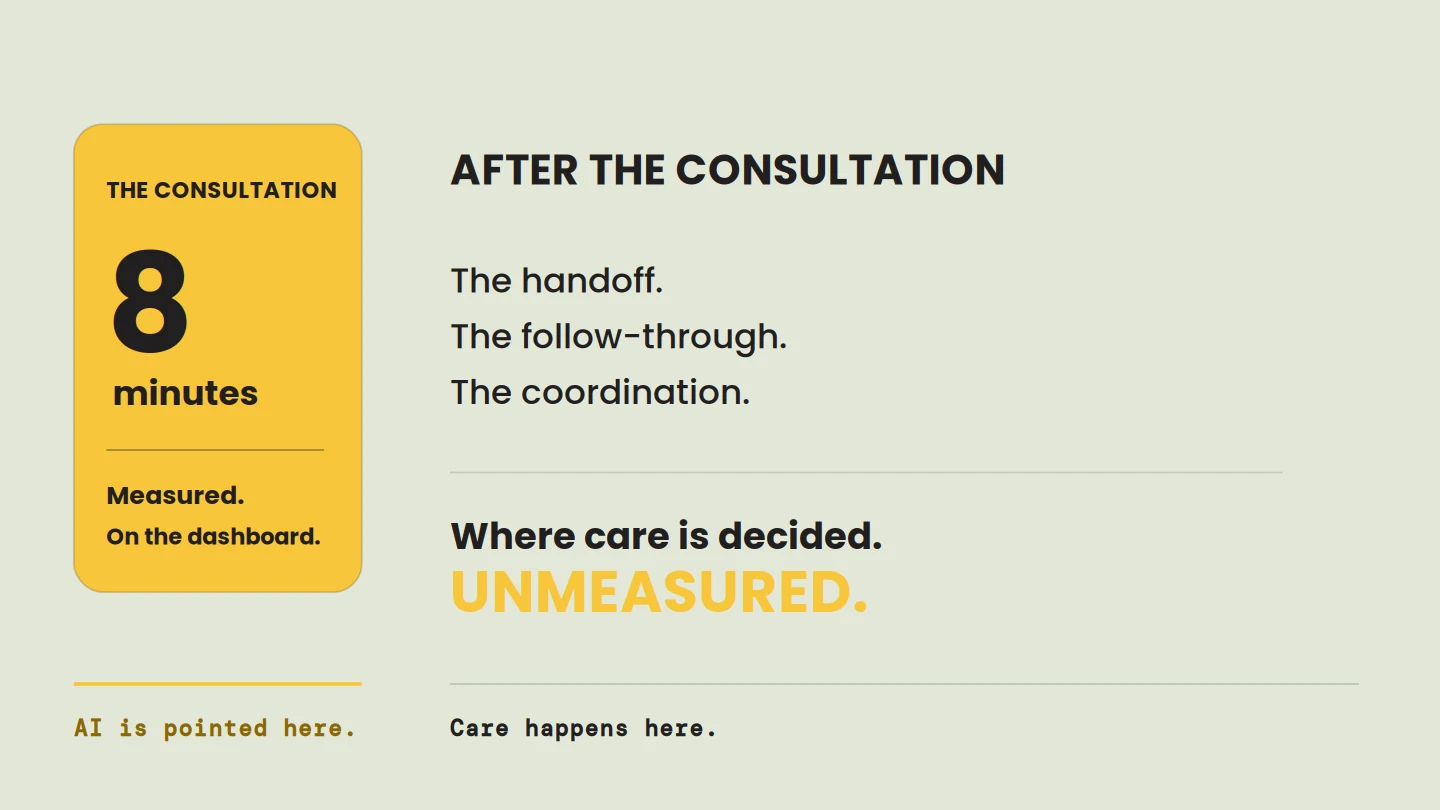
It's not wrong. It's aimed at the wrong eight minutes.
The consultation is the easiest part of care to measure.
It happens in one room, with one clinician, in a fixed window of time.
You can record it, transcribe it, time it, score it.
So that's where the intelligence gets pointed: at the decision itself, the diagnosis, the plan, the note. The decision gets faster. Everything that decision has to survive afterward stays exactly as it was.
Three things stay broken in particular.
A consultation ends. The plan is clear. Everyone in the room nods.
Two days later, the phone rings.
It isn't because the decision was wrong. It's because what came next was never made clear enough to act on.
An instruction that made sense out loud doesn't always make sense written down, and sometimes it gets written down and nobody reads it the way it was meant.
Follow-up gets assumed instead of owned, which in practice means it belongs to no one.
The next team in the chain inherits a decision stripped of the context that produced it, so they end up reconstructing intent instead of executing a plan.
None of this shows up as a clinical failure. It shows up as a patient calling back, or worse, not calling back at all.
The instinct is to read that as a patient problem: didn't follow the instructions, didn't understand the plan, didn't come back when they should have. It almost never is.
The system asked someone to retain and act on information it never finished delivering, then quietly stepped back.
A patient who calls back confused isn't failing to follow through. They're surfacing the one part of the process that was never actually finished.
This isn't abstract. One of the patient partners at Geneva's HUG put it plainly in a recent conversation: she reviews every information brochure before it leaves the hospital with someone, and her point was simple.
A brochure can do enormous good or enormous harm, because nobody reads it sitting next to their doctor. People read it alone, at home, exactly when they're fragile and need answers, with no one there to give them.
That's not a detail. That's the moment the instructions either land or don't.
That conversation is episode 2 of À L'UNISSON, the podcast on patient experience and partnership at HUG. Watch it on YouTube or follow the podcast on LinkedIn.
This is where it gets expensive for the people running these organizations, not just uncomfortable.
Patient experience and employee experience get tracked as if they're two separate scorecards, with separate owners and separate initiatives.
They break in the same place, for the same reason.
The 'after' isn't a footnote to care. For most patients, it's where care is actually experienced.
The decision happens in a room they leave in minutes.
Everything that follows, whether the plan held, whether anyone they reached out to actually knew what was going on, whether the next person in the chain had the full picture, plays out over days and weeks.
That's the part being measured least and felt most.
None of this means the tools in the consultation room are wrong to build.
It means they're solving the part of the problem that was already easiest to solve.
The harder, more valuable move is pointing that same intelligence, and that same attention, at what happens once the room empties: the handoff, the follow-through, the parts of care currently invisible to any dashboard because no one built a way to see them.
So before the next AI pilot gets scoped around the consultation, it's worth asking a blunter question: what happens to this decision the moment it leaves the room, and who, exactly, is responsible for making sure it survives?
It speeds up the note and frees clinician time in the room. That helps. But the note is the easiest part of care to improve, because it sits in one place and can be measured. Most of what determines whether care holds happens after the consultation: the handoff, the follow-up, the coordination between teams. AI clinical documentation rarely touches that layer.
An AI medical scribe, or ambient documentation tool, listens to a consultation and turns it into a structured clinical note in seconds. It removes typing and speeds up records. What it does not do is carry the decision forward. Once the note is written, the follow-through still depends on people, workflow, and handoffs the tool never sees.
Care coordination breaks between people, not inside the note. A decision made in one room has to reach a nurse, a coordinator, the next clinic, often without the context that produced it. AI points at the moment that is easy to measure, the consultation. Coordination lives in the weeks after, in handoffs no dashboard tracks and no scribe records.
It gets handed to people asked to act on it without the authority or context to do so. An instruction that made sense out loud does not always survive being written down. Follow-up gets assumed instead of owned, so it belongs to no one. The decision was rarely designed to travel, so when it reaches a handoff, it stalls.
A handoff is the moment responsibility for a patient moves from one person or team to the next. It fails when the decision arrives stripped of the context that produced it. The receiving team reconstructs intent instead of executing a plan. Nothing shows up as a clinical error. It shows up as a patient calling back, or not calling at all.
They break in the same place, for the same reason. A nurse fielding a confused callback two days after discharge is absorbing the cost of a handoff nobody designed. A coordinator chasing an unclear follow-up is doing the work the system left undone. Track them as two separate scorecards and you miss that one failure produces both.
Whether the plan held. Whether the people the patient reached actually knew what was going on. Whether the next team in the chain had the full picture. These are the parts of care felt most and measured least, because no one built a way to see them. The consultation shows up on a dashboard. The weeks after do not.
Inside the consultation, yes. It drafts the note, the summary, the letter, and gives time back. The administrative burden that does not lift is the coordination work after: chasing follow-ups, reconstructing context, closing loops nobody owns. That load sits with nurses, coordinators, and the front desk, and it rarely reaches the tools built for the room.
Usually not because the decision was wrong. Because what came next was never made clear enough to act on. An instruction read alone at home, when a patient is fragile and has no one to ask, lands very differently than it did in the room. A confused callback is not a patient failing to follow through. It is the part of the process that was never finished.
At what happens once the room empties. The handoff, the follow-through, the coordination between teams: the parts of care currently invisible to any dashboard because no one built a way to see them. The tools in the consultation room are not wrong. They solve the easiest part. The harder, more valuable move is pointing the same intelligence at the after.
.png)


We train managers alone, then ask them to succeed as a team. What clinical simulation teaches management training, in every sector.
When development, recruitment and performance stop building the capabilities you need, your competency framework may be the cause. Three shifts, one test.
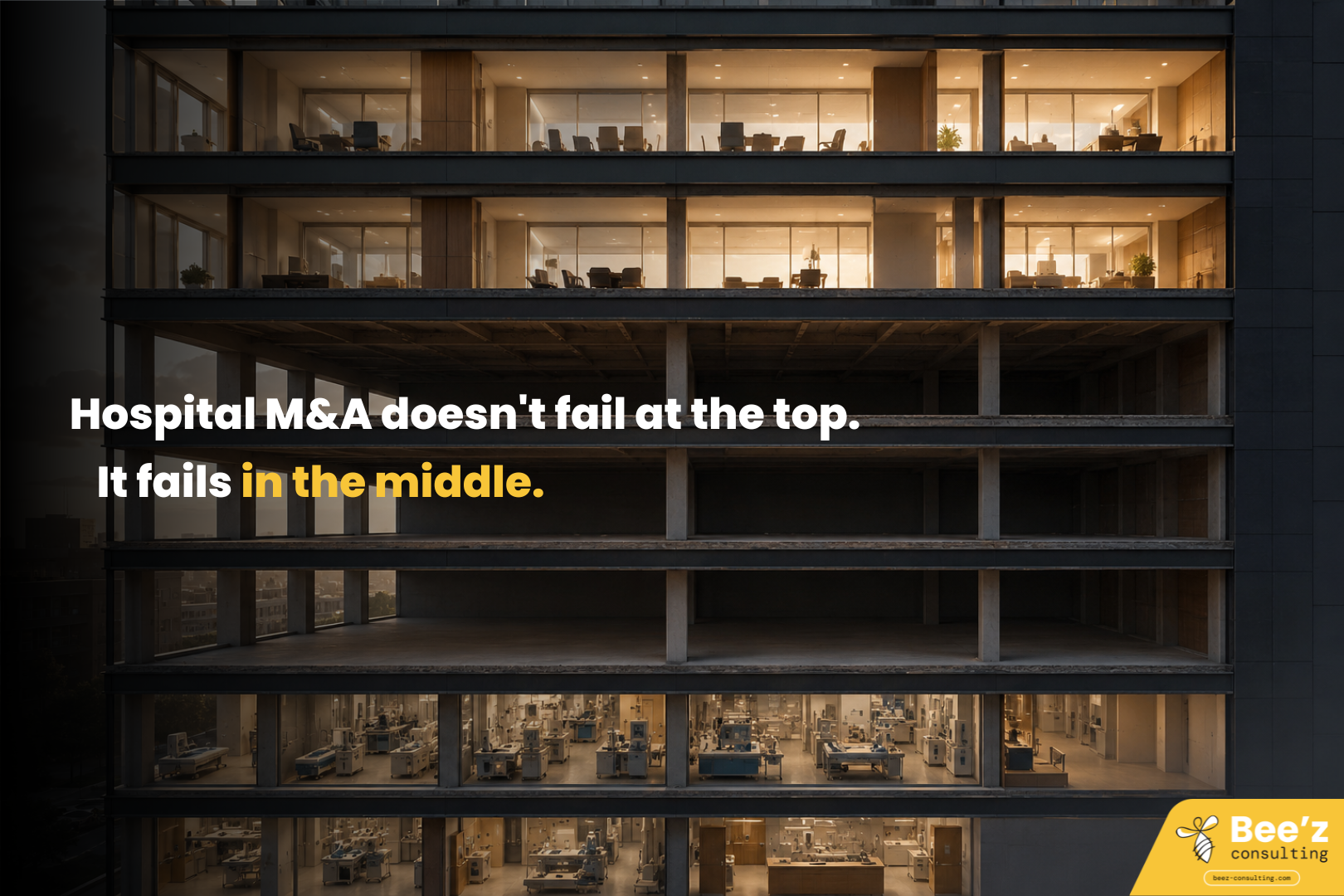
Hospital M&A fails not at the top but in the middle layer. Here is what the governance vacuum looks like and what leaders who see it do differently.

