
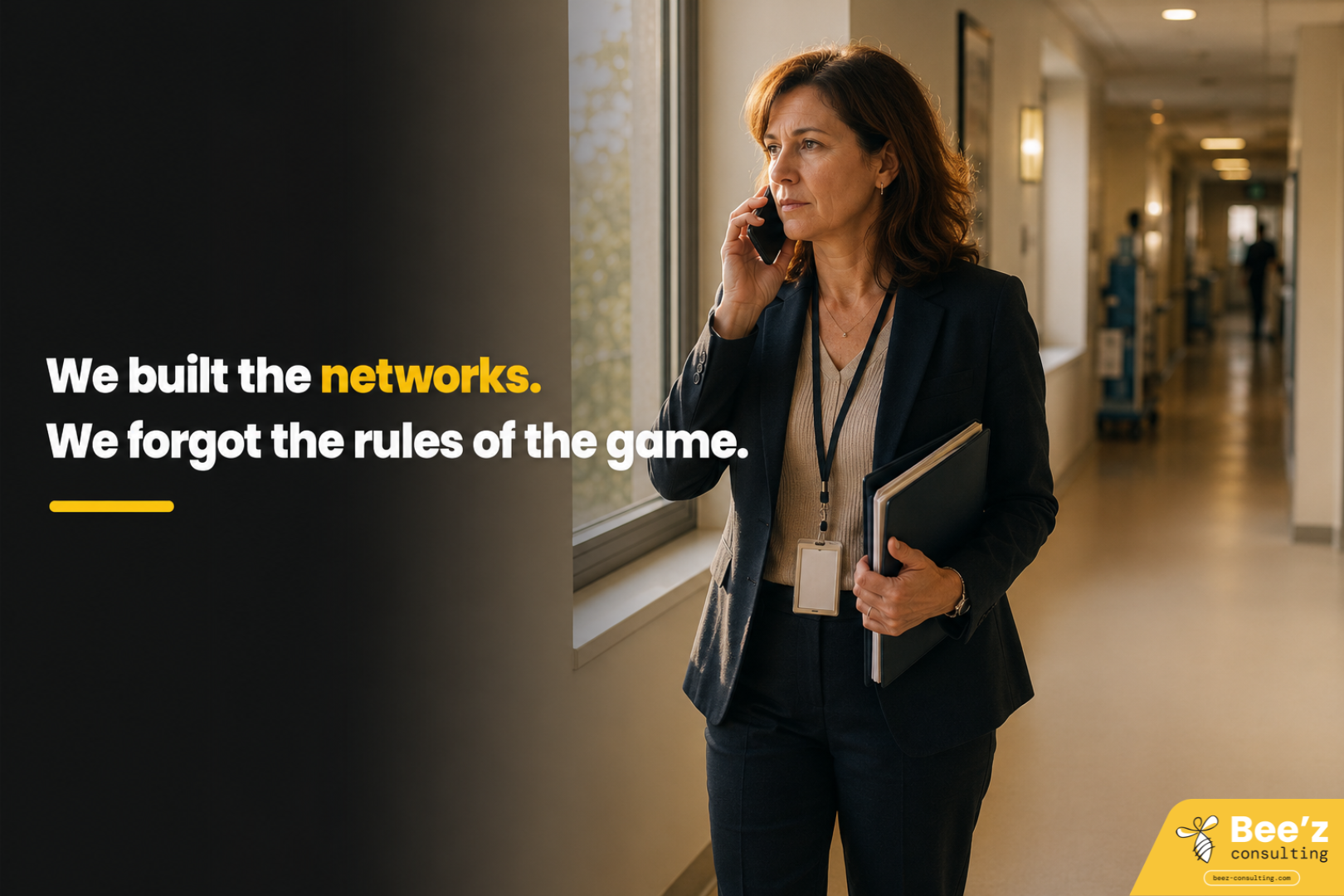
Friday. 4:45 PM.
A care coordinator gets a call. A patient is being discharged in an hour. Operated on that morning, home by evening — exactly what the new model intended.
But the GP isn’t reachable.
Home care hasn’t been confirmed.
The file mentions an anticoagulant treatment no one has explained to the patient.
And his wife, who was supposed to monitor his evening medication, just called to say she doesn’t understand the instructions.
The nurse does what she does every Friday.
She improvises. She calls. She fills the gaps.
This isn’t individual failure. It isn’t a lack of goodwill. It’s the daily reality of a system that changed shape without changing how it operates.
On what happens when the handoff breaks: Why Healthcare Handoffs Break
Across Europe, the same ambition: move care out of hospitals, anchor it in communities, bring it closer to patients.
The structures are taking shape.
- In the UK, GP networks coordinate primary care and interface with integrated community teams.
- In France, more than 700 territorial health communities now cover 92% of the population.
- In Switzerland, five hospitals across four cantons just created the country’s first inter-cantonal care network.
- In Germany, the first multi-professional health centers are emerging in urban neighborhoods.
The funding is shifting.
What hasn’t changed yet is what happens inside.
Two leaders meet.
One comes from the hospital. The other represents home care.
They get along. They want the same things for their patients.
Then comes the real case.
A complex patient.
Two teams involved.
A decision to make.
Each one waits for the other to go first.
No one defined who decides in this configuration.
This isn’t a goodwill problem. It isn’t a structural problem either. It’s a rules problem. The rules haven’t been written yet.
Tariff reforms create the financial conditions for change. They don’t create the human conditions.
For context on the shift: The ambulatory shift in France · BAG Switzerland
What ambulatory transformation requires first is an agreement on shared rules.
Not an org chart.
Not a signed charter filed away in a drawer.
Concrete answers to simple questions.
- Who owns the patient pathway when it moves from one actor to the next?
- Who calls whom, in what timeframe, with what information?
- Who decides when two teams disagree on priority?
These questions seem obvious. They are.
What’s less obvious is having answered them together, formally, with every actor in the network.
And when the rules are missing, someone invents them. Usually, it’s the nurse at 4:45 on Friday.
Three things to build together.
.png)
The systems that succeed won’t be the ones with the best structures.
They’ll be the ones with the best rules of the game.
On what this means concretely in Switzerland: Inside Swiss Healthcare Transformation
A healthcare manager takes on a new role in a territorial network. Solid training. Recognized experience.
In the first few weeks, he realizes his daily work looks almost nothing like what he mastered.
He has to collaborate with partners he didn’t choose.
Persuade without hierarchical authority.
Manage transitions he only partly controls.
Make sure critical information reaches the right person, at the right time, intact.
No one prepared him for this.
Three new competencies the role demands.
.png)
This isn’t training. It’s a different relationship to work. And it takes time.
On what happens after the consultation: AI and Clinical Documentation: The Gap After the Consultation
A director looks at their dashboards.
Occupancy rate.
Average length of stay.
Number of procedures.
Everything on track.
Three weeks later, the same patient is back in the ER.
The system worked. The pathway broke somewhere.
If the shape of care changes, the way we measure must change too.
A model centered on procedures and stays measures what happens inside each facility.
A model centered on patients and territories measures what happens to the patient over time.
Are they getting better?
Do they understand their condition?
Are they avoiding unnecessary hospitalizations?
Can their caregivers hold on?
This shift from procedures to outcomes, amd from walls to pathways is what some systems have begun calling value-based care.
It’s not just a technical choice. It’s a cultural one.
It requires actors to accept being evaluated together on what they produce collectively.
And that may be the deepest transformation of all.
You don’t manage a care network with hospital metrics.
On how Europe is redefining performance in healthcare: From Bigger to Better
At the center of all of this, there is a person.
Care coordinator. Department head. Sector manager. Healthcare manager in a territorial network.
An ordinary morning for this person:
She manages. She filters. She translates. She holds.
This role isn’t new. What’s new is its scope.
Before, you managed a department. Now, you orchestrate a network.
These aren’t the same competencies. These aren’t the same days.
And in most organizations, no one has yet defined what that means concretely, or prepared people to do it.
This isn’t a people problem. It’s a role poorly defined for a world that has changed.
On what happens when this role isn’t supported: Stop Blaming the Middle. Start Supporting Your Managers
The movement is underway. The structures are taking shape.
What will determine whether it holds — whether it produces better care, a better experience, lasting results — is what gets built inside.
Three questions for the leaders navigating this transformation.
Europe’s best care networks won’t succeed because they reformed their tariffs. They’ll succeed because they prepared the people who hold the system together.
On what actually breaks the patient experience: What Actually Breaks the Patient Experience
Ambulatory care transformation refers to the shift of healthcare services from hospitals to community-based structures — GP networks, community health centers, home care.
The goal is to treat more patients in their daily environment, reducing unnecessary hospitalizations.
Tariff reforms create the financial conditions for change.
They don’t define who decides what, or how teams collaborate daily.
Without clear governance rules, the network functions structurally but fails in execution.
Three rules are fundamental.
- Who owns the patient pathway from one actor to the next.
- Who escalates and who decides in gray zones.
- How accountability for patient outcomes is shared between organizations.
These rules don’t emerge naturally. They are built, explicitly, together.
Inter-organizational collaboration is learned.
It requires listening to patients and families differently, trusting partners you didn’t choose, and using digital tools to ensure care continuity.
This isn’t training. It’s a different relationship to work.
Family caregivers are often the first to hold the pathway together at home.
Integrating them into clinical decisions and co-constructing what is realistically feasible is a condition for success, not an option.
Classic hospital metrics — occupancy rate, length of stay — are insufficient.
Network performance is measured by what happens to the patient over time.
- Health improvement.
- Avoided hospitalizations.
- Caregiver resilience.
Value-based care evaluates healthcare actors not on the volume of procedures produced, but on the outcomes achieved for patients.
This model requires organizations to accept being evaluated together on what they produce collectively.
In a territorial network, the middle manager no longer manages a department.
They orchestrate.
They collaborate with partners they didn’t choose, persuade without hierarchical authority, and ensure information continuity between teams.
Digital tools and AI enable a clinical decision made at the hospital to reach home care intact the next morning.
But a tool changes nothing if the practices around it haven’t changed.
Success rests on three human and organizational levers.
- Pathways co-built between all actors.
- Explicit governance rules.
- People — especially middle managers — prepared to work differently in a network.
.png)

When development, recruitment and performance stop building the capabilities you need, your competency framework may be the cause. Three shifts, one test.

Hospital M&A fails not at the top but in the middle layer. Here is what the governance vacuum looks like and what leaders who see it do differently.
Across Europe, care is moving out of hospitals. What will determine whether it works: the operating rules inside networks, and preparing the people who run them. 3 operational keys.

