
%20(1).png)
Two years of Forbes and Statista culture rankings
Two different lists.
The same pattern in both.
Pharma near the top.
Medtech in the middle.
Hospital systems further down, with a handful of exceptions that are worth looking at carefully.
That consistency is not a coincidence.
And it is not a story about which sector cares more about its people.
Forbes and Statista have been measuring company culture across sectors since 2025.
The methodology is consistent: independent surveys of employees on fairness, growth paths, training quality, and whether they would recommend their employer.
More than 217,000 people surveyed in 2026. More than 218,000 in 2025.
The numbers shift year on year. The sector distribution barely does.
In 2025, medtech names like Boston Scientific ranked 66th, Intuitive Surgical 228th, and Medtronic 239th.
Hospital systems were largely absent from the upper half of the list.
In 2026, pharma names dominate the top 100: Johnson and Johnson at 8th, Vertex Pharmaceuticals at 46th. Hospital systems average between 200th and 400th place, with MD Anderson at 2nd as the most notable outlier.
The organisations that rank consistently well across both years are not the ones that launched culture initiatives between 2025 and 2026. They are the ones that built something structural years, sometimes decades, earlier.
Rankings measure outcomes. What produces those outcomes is the more interesting question.
Healthcare has the strongest mission of any sector.
Nobody goes into nursing, clinical research, or hospital management because they ran out of better options.
So the culture gap between pharma and hospitals is not a mission gap.
It is not an engagement gap in the sense that most employee experience programmes understand that term.
It is a management infrastructure gap.
The organisations that rank well consistently share one structural characteristic: people in the middle of the organisation, the ones connecting strategy to daily operations, have what they need to act.
They have frameworks for decisions under pressure.
They have channels to surface contradictions upward without it costing them credibility.
They have a clear enough mandate that when two legitimate priorities conflict, they can resolve it without waiting three weeks for an answer from above.
That infrastructure is not visible on a values statement or a strategy slide.
It lives in how a ward manager handles a staffing contradiction on a Tuesday morning.
It lives in whether a country affiliate can adapt a global directive to local operational reality.
It lives in whether a clinical team leader can surface a problem before it becomes a crisis.
Consider what happens when that channel does not exist.
A senior nurse in a French clinic spent two years flagging the same coordination problem between radiology and her ward. She raised it in team meetings, in her annual review, and once in writing.
Nothing changed structurally.
In year three she stopped raising it.
The problem did not go away.
The channel simply did not exist, and she had learned that using it cost more than staying quiet.
When that infrastructure is absent, the symptoms look like disengagement, slow execution, and high turnover.
Most organisations respond with communication programmes, engagement surveys, and leadership training.
The surveys stay flat.
The turnover continues.
The initiatives stall.
The cause was structural.
The response was not.
Pharma did not build management infrastructure because its leaders were more enlightened.
They built it because the economics of talent in a competitive private market made the cost of not building it visible on a balance sheet.
A pharmaceutical company losing a senior medical science liaison or a regional sales manager to a competitor can calculate that cost precisely.
Recruitment fees, ramp-up time, client relationship disruption, lost market access.
The number is large enough that investing in the conditions that make people want to stay became a business decision, not a values decision.
Over two decades, that investment compounded.
Decision frameworks.
Structured manager development.
Escalation channels that work.
Cross-cultural operating models for the affiliates that run global programmes in local contexts.
That last point is worth a short detour.
A country manager at a European medtech affiliate once described receiving a global change programme designed entirely for the US market.
He adapted it informally, rewrote the materials, and ran a parallel version that reflected how his market actually operated.
His results were stronger than the global average.
When his regional director asked how, he walked through what he had done. Nobody formally captured it.
The next programme arrived the same way, from the same headquarters team, with the same assumptions baked in.
This is what management infrastructure looks like when it is partially built.
The individual compensates brilliantly.
The organisation never learns.
The next person in that role starts from zero.
The companies that built this infrastructure early now rank consistently well because the infrastructure produces the outcomes the rankings measure.
Hospital systems operated under different economics.
Public funding, fixed salary grids, professional identity as the primary retention mechanism.
The cost of losing a nurse was real but harder to attribute to a specific infrastructure deficit.
So the deficit persisted.
Medtech sits between the two, which is exactly where it appears in the rankings.
That structural difference was sustainable when the talent supply was stable.
It is no longer sustainable.
Nursing and physician shortages across Switzerland, France, Belgium, and the Netherlands are not temporary.
The pipeline of new professionals entering the system is too small to replace the ones leaving or reducing their hours.
Salary increases have a hard ceiling in most public healthcare systems, and even in regulated life sciences environments where compensation bands are fixed by function.
The organisations in pharma, medtech, and biotech that have grown quickly and relied on compensation and mission to attract people are now discovering the same constraint.
When the market tightens and a competitor can match your offer, culture becomes the differentiator.
And culture in practice means what it feels like to work inside your middle layer every day.
The talent shortage has made the management infrastructure gap expensive for every sector.
The difference is that pharma already has infrastructure to build on.
Most hospitals are starting from an earlier point.
Younger biotech and medtech organisations that grew fast without investing in management structure are discovering a gap they did not know existed.
The exceptions in the rankings are worth examining because they demonstrate that sector is not destiny.
MD Anderson Cancer Center at 2nd place in 2026.
Houston Methodist ranked first in Glassdoor's inaugural healthcare, biotech and pharma category in 2026.
Both are hospital systems. Both invested deliberately in the conditions that let people in the middle of the organisation act effectively.
Several children's hospitals also appear disproportionately high across both years.
The likely explanation is that mission clarity at the unit level produces cleaner decision architecture.
When a ward has a single unambiguous priority, the infrastructure around competing pressures becomes simpler to maintain.
What changes when that infrastructure exists becomes visible in situations where pressure is high and the decision is genuinely difficult.
In a leadership simulation at a medtech organisation, a participant was given two directives with equal weight from above: protect the quarter's commercial target or escalate a patient safety issue that would cost four weeks of delay.
She escalated the patient safety issue without hesitation.
When the debrief asked what she would need to make that call in real life with the same speed, her answer was immediate: a framework she did not have to justify from scratch every time, and a clear signal from above that using it was expected rather than exceptional.
That combination, the framework and the signal, is what management infrastructure produces.
The ranking is what it looks like from the outside three years later.
There is a single diagnostic question that cuts across sector, size, and geography.
When someone in the middle of your organisation has two competing directives and needs to decide which one gives way, what happens?
Do they have a framework for that decision? A channel to surface the contradiction before it costs anything?
A clear enough mandate that they can act without waiting for permission from three levels above?
If the answer is consistent across teams and does not depend on who the manager is or how long they have been there, you have management infrastructure in place.
The rankings will reflect it eventually.
If the answer varies by person, by team, or by how well a manager knows her direct superior, you have individuals compensating for a structural gap.
The rankings reflect that too.
We put together a short diagnostic tool.
Four questions.
Fifteen minutes.
It maps where your organisation sits on the infrastructure maturity scale and points to one concrete thing to do first.
Download the Tuesday Morning Test (link)
And if this is a question you keep coming back to, the Hive Signals newsletter goes deeper every two weeks. Practical thinking for healthcare and life sciences leaders on culture, middle management, and the gap between strategy and what actually happens on the floor.
Subscribe to Hive Signals beez-consulting.com/newsletter-subscription
Forbes / Statista, America's Best Employers for Company Culture 2026. Based on surveys of 217,000+ US employees.
Forbes / Statista, America's Best Employers for Company Culture 2025. Based on surveys of 218,000+ US employees.
Glassdoor Best Places to Work 2026: Healthcare, Biotech & Pharma. Houston Methodist ranked #1.
Becker's Hospital Review, coverage of Forbes culture rankings 2025 and 2026.
.png)


When development, recruitment and performance stop building the capabilities you need, your competency framework may be the cause. Three shifts, one test.
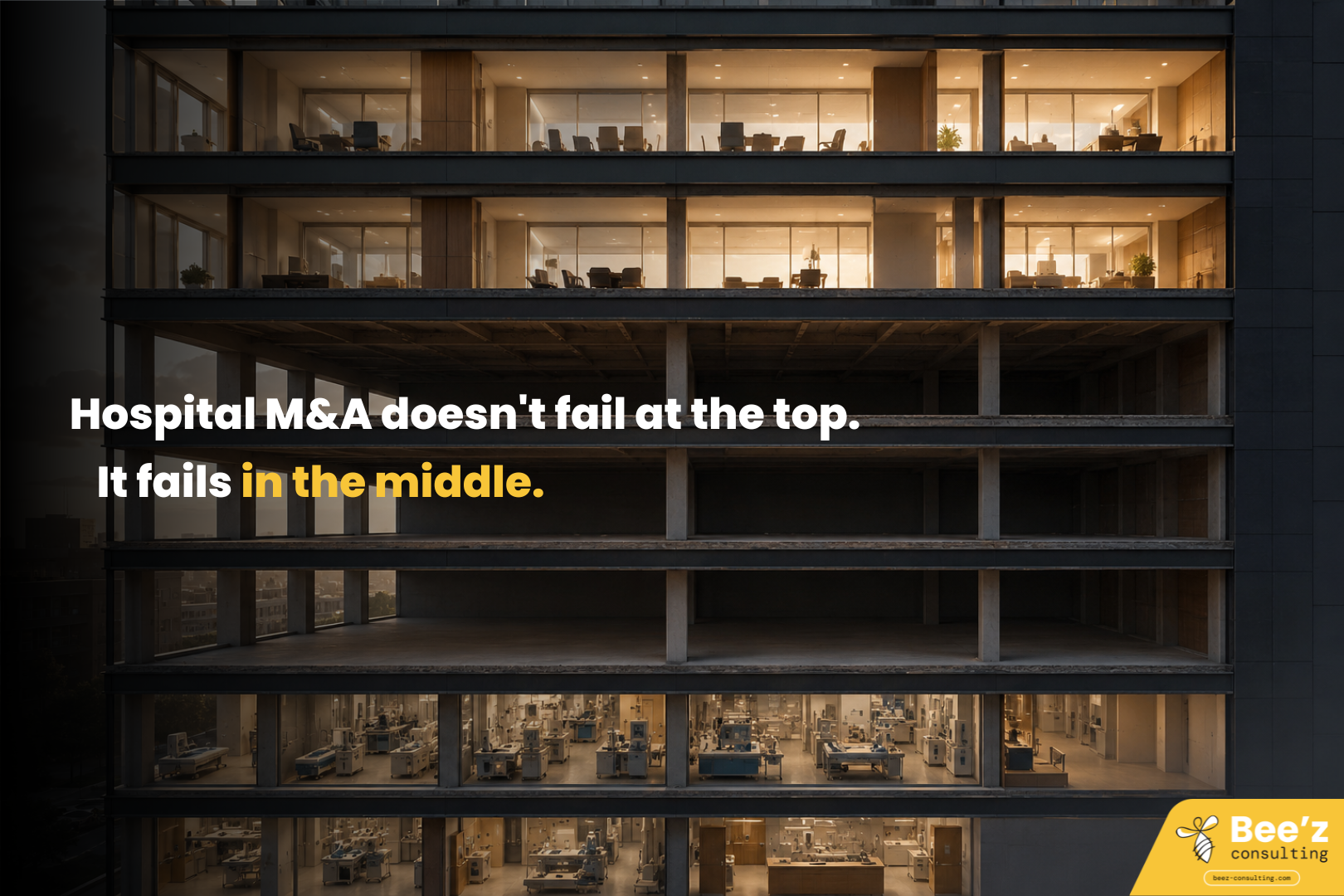
Hospital M&A fails not at the top but in the middle layer. Here is what the governance vacuum looks like and what leaders who see it do differently.

Across Europe, care is moving out of hospitals. What will determine whether it works: the operating rules inside networks, and preparing the people who run them. 3 operational keys.

