
In many healthcare and life sciences organisations, whether hospitals, clinics, pharma or medtech companies, the same pattern keeps coming back. It just looks different depending on where you sit.
- The executive team launches a new organisation, a new care pathway, new tools, and watches teams follow more slowly than planned.
- The head of nursing, or the head of the business line elsewhere, sees experienced professionals struggling with situations their training never covered, and new hires who aren’t ready for the work as it is done today.
- HR organises training, equips performance reviews, recruits against approved profiles, and the capability gap is still there.
Sooner or later, everyone looks for the cause in the people: motivation, engagement, the quality of candidates.
Often, the problem sits further upstream: the work has changed, and the competency framework hasn’t moved.
Nobody decided it. It is simply what happens when a document freezes work that never stops changing.
We saw a very concrete example of this on À L’UNISSON, the podcast Silvina Layani co-hosts with Charlotte Calemard. Its third episode, on the maternity pathway, welcomed François Millier, a midwife and nurse manager.
Fifty years ago, he said, a woman arriving to give birth mostly let herself be guided.
Today she arrives informed, sometimes distrustful. And refusals of care, once rare, now come almost every week.
Nothing in his training had prepared him for that part of the job.
When the work changes, who rewrites what is expected of people? Usually, the people doing it. On their own.
A competency framework describes what an organisation expects across a family of roles: technical competencies and behavioural competencies, usually set out by level of experience.
Done well, it does three jobs at once:
- it shows people what to grow toward;
- it gives recruiters a basis for assessing candidates;
- it feeds the performance and development conversations between managers and their teams.
In healthcare, frameworks are often inherited from professional bodies.
In the United States, physician training is still built around six core competencies defined by the ACGME in 1999: patient care, medical knowledge, practice-based learning and improvement, interpersonal and communication skills, professionalism, and systems-based practice.
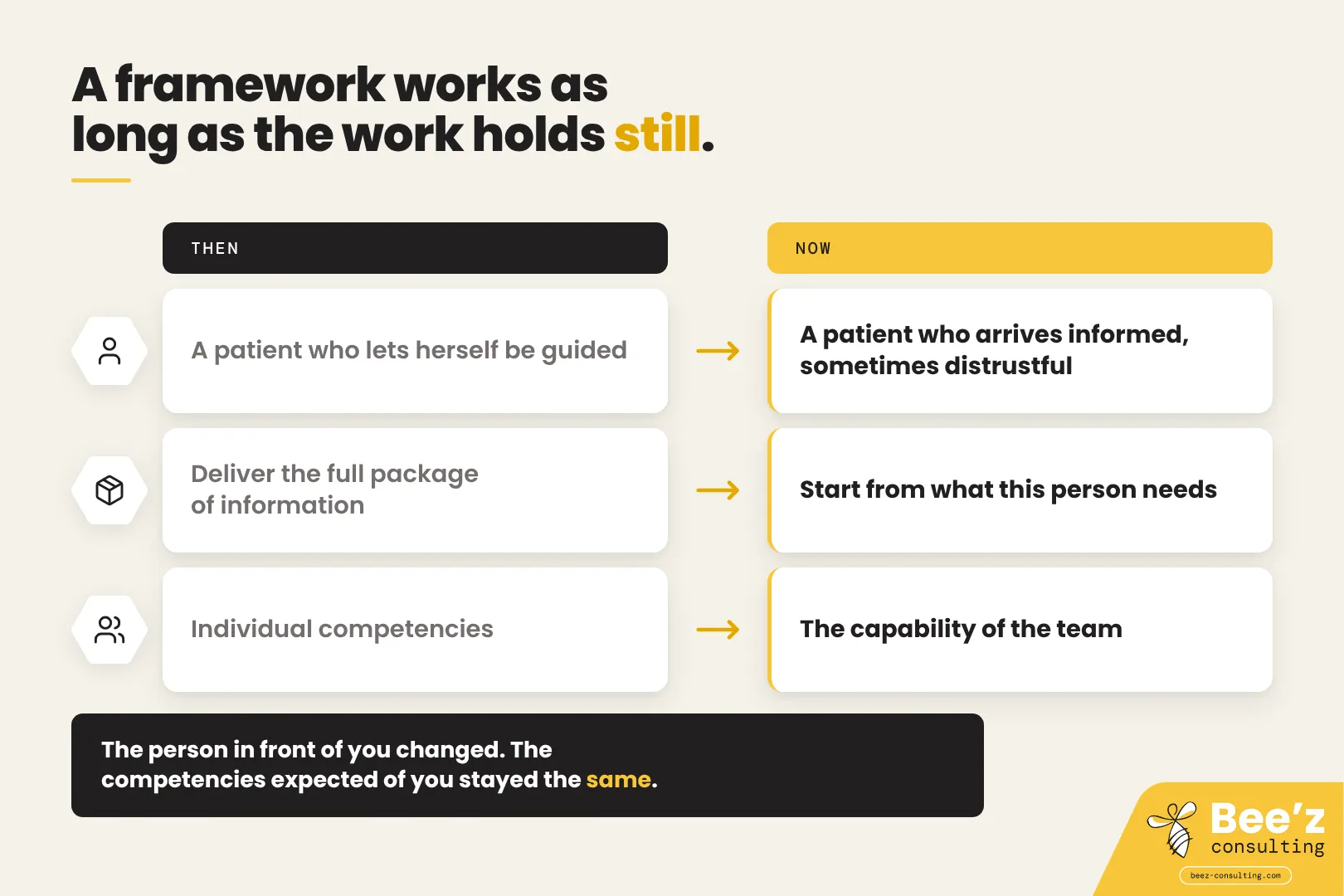
A framework works as long as the work holds still.
Look closely at what changed in François’s work and three shifts appear.
We see the same three, in different forms, in hospitals, clinics and life sciences organisations.
We described one version of this in August, with a nurse manager in a new care network whose daily work had little left in common with what they had mastered: Ambulatory Care Transformation: What Will Actually Make It Work
Patients and clients arrive with information, expectations and opinions they did not have twenty years ago.
Some of that information helps. The rest is, as François puts it, everything and its opposite.
Serving that person well takes things no framework mentions:
- explaining a risk to someone who read the opposite last night;
- negotiating a refusal without losing the relationship;
- documenting what was said and declined, in case a complaint follows.
All of it with fewer and fewer staff at the bedside.
The person in front of you changed. The competencies expected of you stayed the same.
In François’s world, the content of the job itself has moved. Clinicians are trained to deliver a full package of information to every patient.
His approach runs the other way: first understand what this person needs, then draw from that package what is useful to her right now.
It is the spirit of the international “What matters to you?” campaign, run every year in many countries to make that question a reflex in care.
For François, it should not depend on a campaign.
It should be the default way of working.
The midwife becomes a coach and a conductor.
She builds the care with the person.
The days when clinicians held all the answers are over, he says.
That is the whole difference between a skill and a competency.
A skill is something you can do: a technique, a procedure, a gesture.
A competency is how you use it in a real situation, with judgement, with other people, often under pressure.
You can master the first and still be missing the second.
The same shift runs through other professions. Take an accountant.
Technical competence gets them hired. Then the job asks them to translate complexity for clients, deal with the tax authorities, work with stakeholders who think differently.
Their technical competencies cover the first half of that job. The second half rests on behavioural competencies that frameworks rarely describe as they have become.
We see the same gap with our clients, in hospitals and in life sciences companies, every time an expert becomes a manager: a respected clinician becomes a nurse manager, a specialist takes over a team. Often, they keep the expert’s posture and answer every question.
The role now asks for a coach’s posture: open the discussion and help others find the answer. The leadership framework, where there is one, rarely says that the job they excelled at is over.
And a posture does not change because someone has read its new definition.
This shift also depends on the organisation giving managers what they need to make it: Stop Blaming the Middle. Start Backing Your Managers
AI is taking over tasks people used to do.
Teams merge.
Roles are split across organisations that did not work together before.
Florence Dambricourt, who works with managers and their teams, asks a direct question: if AI takes over this task, how does the person who did it keep growing?
That is what separates competency from capability.
Competency is what a person can do.
Capability is what a person or a team can actually deliver, in the real context, with others.
Florence puts it simply: a team is not the sum of its members. It is the sum of its interactions.
Most frameworks describe the competencies of individuals. The work depends more and more on the capability of teams.
Three things happen when the work moves and the framework stays where it was.
- The organisation keeps developing and recruiting for the old version of the job, while the reality of the work has changed. That creates confusion: performance should be steered toward the new picture, and a gap opens between the capabilities being developed or brought in with each hire and the ones the work now needs.
- Managers cannot coach toward something nobody has named. In a live session on building stronger teams, Florence described asking leaders what their team needs to learn in the next six to twelve months. In her experience, more than 70% of them cannot answer.
- People close the gap on their own. Like François and his team, they reinvent their work week after week, with no frame to help them learn what it now demands.
People aren’t failing to grow. They’re growing toward a job that no longer exists.
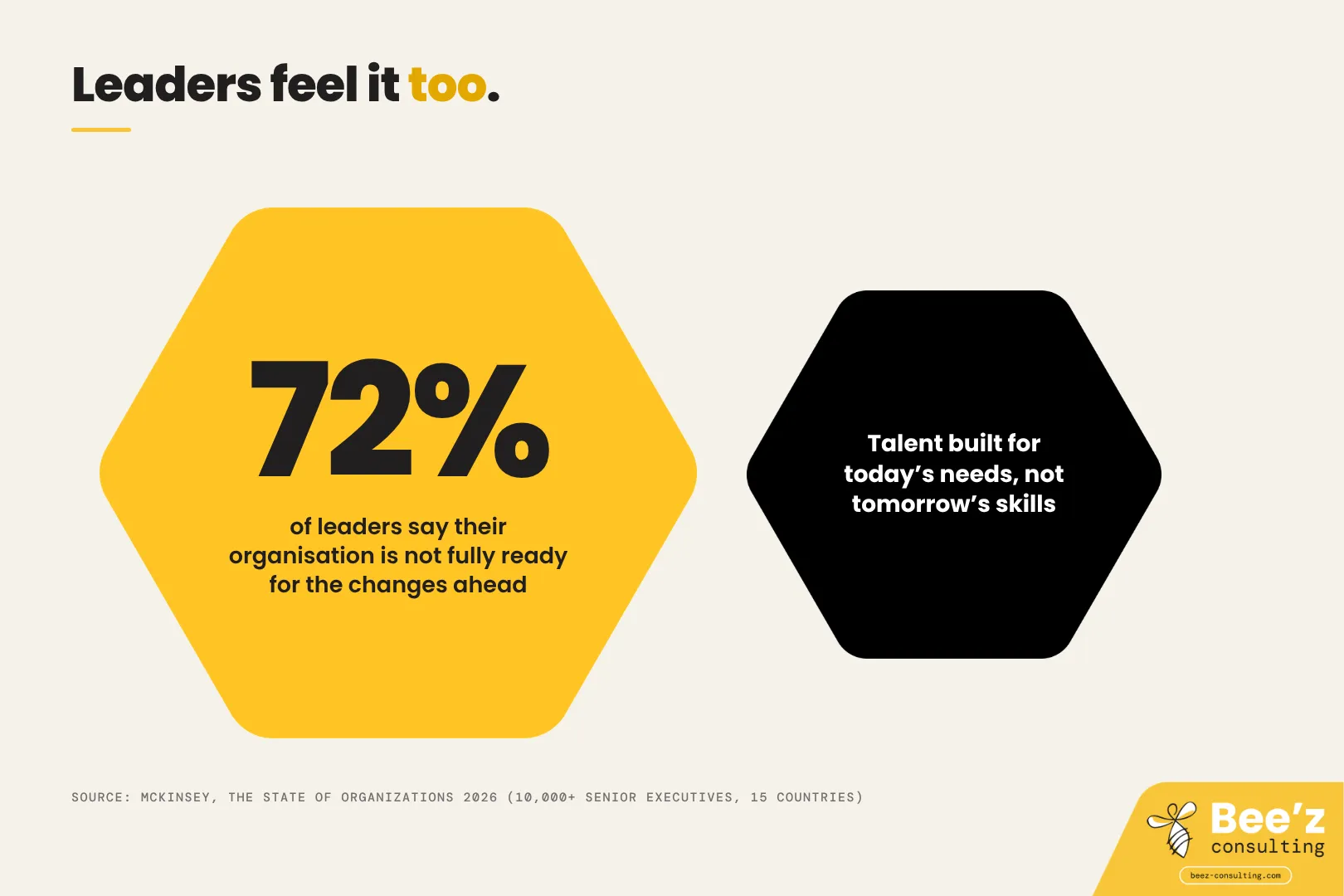
Leaders feel it too. In McKinsey’s The State of Organizations 2026, a survey of more than 10,000 senior executives in 15 countries, 72% say their organisations are not fully ready to face the changes ahead.
The same report names a structural mismatch: many organisations have built their talent around what the business needs today, not the skills it will need tomorrow.
When the problem comes more from the time and authority managers are given, we described it here: Why Healthcare Transformation Stalls in the Clinical Middle
Treat the framework as a living reference, rewritten with the people who do the work whenever the context changes significantly.
One pharmaceutical organisation we worked with was moving to agile ways of working. Its existing framework listed qualities.
The new one was built differently, as a capability architecture. It describes what each role must deliver in the new way of working, as behaviours you can observe.
It became the basis for hiring, succession and performance decisions, which became fairer and more consistent.
A framework is not reviewed every year, and that is normal. But some signals show it has fallen behind:
- a new tool, or AI, takes over part of the tasks;
- a merger, a reorganisation or a new care pathway changes how the work is done;
- what patients or clients expect shifts noticeably;
- experienced people struggle with new situations, or new hires who match the profile are not ready.
- Start with one family of roles, the one that changed most, rather than the whole framework.
- Write it with the people who do the work, managers included, as observable behaviours. François says it plainly: the profession has to deconstruct the way it approaches things.
- Describe the capability of the team, not only that of individuals. Florence asks every team one simple question: what do you need to learn together in the next twelve months?
- Connect it to its three uses: development plans, recruitment criteria, performance conversations. Without that link, it goes back to sleep in a drawer.
- Executive team: for every transformation decision, ask which roles it changes, and who updates what is expected of the teams.
- Head of nursing or head of the business line: pick the pathway, unit or team that has moved the most, and run the test below with a few professionals and their managers.
- HR, L&D, organisational development: check that recruitment criteria and the development offer point to the work as it is done today.
For the structural side of this, see: Your hospital does not have a culture problem. It has an infrastructure problem.
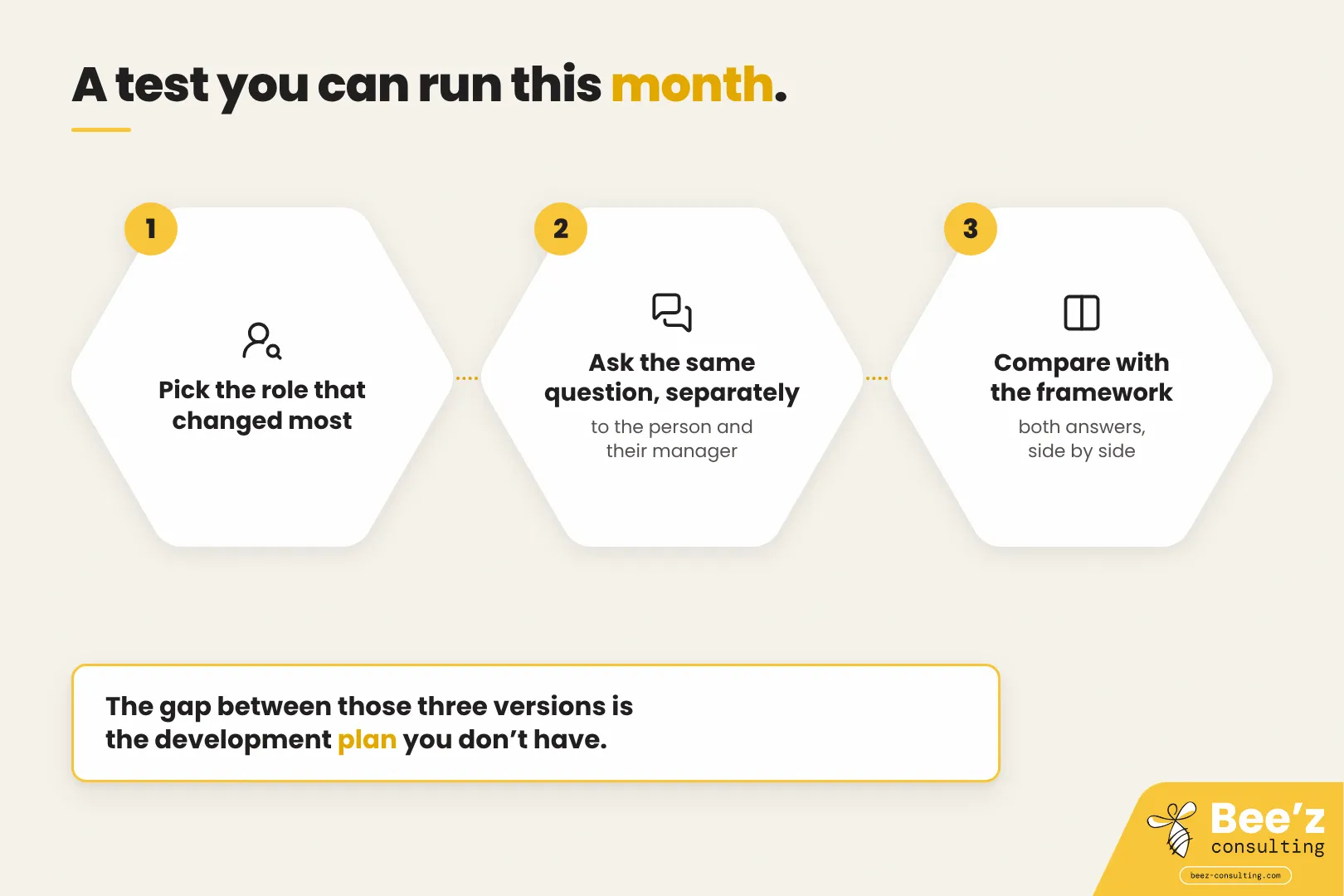
Pick the role in your organisation that has changed most in the last two years.
Ask the same question, separately, to the person in the role and to their manager: what does good look like in this role today?
Put both answers next to the competencies the framework sets for that role.
Listen to what the answers talk about. An objective says what has to be achieved; a competency says how you get there, repeatedly, in the real situations of the role.
When performance conversations only cover objectives, this test quickly shows what is missing: the way of working the role now requires.
The gap between those three versions is the development plan you don’t have.
François’s job has already been rewritten, by him and his team, week after week, with no document to guide them.
The same is happening in most roles that changed in the last two years.
So who rewrites what is expected of people? The people doing the work, as always.
The difference is whether the organisation does it with them, rather than keep preparing, recruiting and developing people for work that no longer exists.
Once the work is rewritten, it still has to be learned. And that is where another gap appears.
Many development programmes still deliver information, to individuals, away from real situations. The work, meanwhile, happens with other people, and often under pressure.
Knowing what to do is not the same as being able to do it, together, when it counts.
Healthcare has found another way to learn, for its most critical clinical situations: together, by rehearsing real situations before living them.
Which leaves one question: why is that way of learning used so little for the rest of the work, and almost never to develop managers? That is where we go next.
A competency framework describes what an organisation expects from people across a family of roles. It combines technical competencies and behavioural competencies, set out by level of experience. It is used to guide people’s development, to assess candidates during recruitment, and to feed the performance and development conversations between managers and their teams.
Start with the family of roles that has changed most, rather than the whole framework. Write it with the people who do the work, managers included, as observable behaviours. Describe the capability of the team, not only that of individuals. Then connect it to its three uses: development, recruitment and performance conversations. Without that link, it stays a document on a shelf.
Competency describes what a person can do. Capability describes what a person or a team can actually deliver in a given context, with others. A team can be made of competent people and still lack capability, if its members have never learned to work together on the new situations the work puts in front of them.
A skill is something you can do: a technique, a procedure, a gesture. A competency is how you use those skills in a real situation, with judgement, with other people and often under pressure. You can master a skill perfectly and still lack the competency, for example when a patient refuses a treatment you know how to give.
In a pharmaceutical organisation moving to agile ways of working, Bee’z supported the redesign of a framework that listed qualities. The new framework describes what each role must deliver in the new way of working, as observable behaviours. It became the basis for hiring, succession and performance decisions, which became fairer and more consistent.
In the United States, the ACGME defined six core competencies in 1999 that still shape physician training: patient care, medical knowledge, practice-based learning and improvement, interpersonal and communication skills, professionalism, and systems-based practice. The framework describes medical work well, but it benefits from being reread in light of the new situations care teams face today.
A leadership competency model describes what is expected of someone who leads others: setting direction, developing their team, enabling decisions and supporting change. It becomes essential when an expert is promoted into management. The role then asks them to move from an expert’s posture, which answers the questions, to a coach’s posture, which helps others find the answer.
A technical competency framework describes the knowledge and skills specific to a profession: the techniques, methods and tools. It usually covers the first half of the job. The second half rests on behavioural competencies, such as explaining, negotiating or working with others, which frameworks rarely describe as they have become. Both should be reviewed together when the work changes.
A competency framework is not reviewed every year. It should be revisited when the context and the demands of the work change significantly: a new tool or AI, a merger or reorganisation, a new care pathway, or a clear shift in what patients or clients expect. Another signal: experienced people struggling, or new hires who match the profile but are not ready.
An objective says what has to be achieved, usually within a set time. A competency says how you get there, repeatedly, in the real situations of the role. The two work together: a performance conversation that only covers objectives leaves out the way of working, which is precisely what the competency framework should help develop.
.png)

When development, recruitment and performance stop building the capabilities you need, your competency framework may be the cause. Three shifts, one test.
Hospital M&A fails not at the top but in the middle layer. Here is what the governance vacuum looks like and what leaders who see it do differently.
Across Europe, care is moving out of hospitals. What will determine whether it works: the operating rules inside networks, and preparing the people who run them. 3 operational keys.

