
François Millier is a midwife and nurse manager. On our podcast À L'UNISSON, he put it with a simple image: finishing your training is like getting your driving licence. Then comes the day you find yourself alone on the road.
His first delivery came on a day the ward was overwhelmed.
Nobody asked him to recite a lecture that day. He had to find his place in a team, and fast.
Clinical training has changed a great deal to prepare people for that moment. Management training, far less. We still send managers to training on their own, then ask them to move a team forward that was never in the room.
What clinical teams have learned applies to any team that has to change the way it works.
In our last article, we looked at expectations that shift without anyone making them explicit. Making them explicit is only half the work. A way of leading doesn't change because someone has read its new definition. It changes through practice, and usually with other people.
Read also: Your competency framework was built for work that no longer exists
Clinical teams no longer train only on their own. They rehearse the critical situations they will face together, through simulation, then look back at what happened in a debrief. What they learn is as much about coordination as about technique.
François calls simulation "a turning point in how we train", in schools and on the wards alike.
Teams rehearse critical situations together before they happen for real: a haemorrhage, a resuscitation, an emergency that arrives at the worst possible moment.
One line from François explains why: "Alone, you can only simulate so much."
In a resuscitation, everyone has a role. Individual technique matters, but it doesn't decide the outcome on its own. For François, "the key to success is communication": who calls what, who checks, who decides when two people read the situation differently.
He adds that you can spot young professionals trained this way. They find their place faster, and they speak up.
Simulation doesn't end with the scenario. Then comes the debrief, where the team looks back at what happened and decides what it will do differently. The learning even carries on in the corridor, with a very simple question: "I'm not sure about this. What do you think?"
Clinicians learn two things together: to act, then to understand and adjust.
The evidence points the same way. A 2016 meta-analysis in the Journal of Applied Psychology brought together 129 studies of multidisciplinary team training in healthcare. Team skills improved in every care setting studied, and the gains carried through to what teams actually did on the job.
In France, the Centre hospitalier Métropole Savoie made the same choice for its managers: around 300 nurse managers, doctors and directors train together in management through simulation.
Look at the moments when a team gets stuck:
- a decision that goes up the line three times before anyone takes it;
- a handover where information gets lost between two departments;
- a difficult conversation involving several people, which everyone hopes someone else will lead.
None of these moments belongs to one person. They happen between people.
Yet management training remains almost always individual. Henry Mintzberg, professor of management at McGill University, put it bluntly: "No one can create a manager in a classroom." A classroom can help, he adds, as long as it starts from managers' real experience.
So the manager comes back on Tuesday, full of good intentions, to a team that experienced none of it.
We described that Tuesday here: Why leadership training fails on Tuesday. And why simulations work.
More information doesn't solve the problem. We see it in almost every project: sometimes information simply isn't the answer. François sees the same thing with expectant parents. They "listen, they hear, but they don't take it in" (translated from French).
A team takes in what it has practised together.
At a healthcare organisation in French-speaking Switzerland, the executive committee made a structural decision: remove a layer of middle management. The very layer it spoke to every day.
The strategy would now have to travel through the organisation without the people who usually translated it.
The approach had two parts:
1. A half-day: the executive committee presented the strategy to all middle managers, then opened a two-way discussion about what it meant for the organisation, for their teams, and for themselves as leaders.
2. Two days of simulation, followed by a debrief. Not because the structure was changing, but because the managers' role was changing: rallying their teams around the strategy and the new momentum. In the simulation, they practised what that means in concrete terms. They chose strategies and tactics, and saw the effect of their choices before they had to do it for real.

You don't announce buy-in. You practise building it.
Practice doesn't stop when the training ends. At a large Swiss company in the middle of a transformation, one team held a fifteen-minute check-in every day. At first it felt like a chore.
A few months later, when a bigger meeting took the place of the check-in, the team felt it. They missed that time to talk with colleagues about priorities, obstacles and how to get past them.
Changing a habit means deprogramming the collective brain. That takes time and repetition.
The need to practise together isn't unique to hospitals. In pharma, medtech, labs, home care and mission-led organisations, managers face the same collective moments: building support, hearing reluctance, keeping trust across distance and anchoring new routines. A few typical situations:
- At a pharmaceutical company, a country medical director rolls out a new operating model across medical affairs, market access and commercial teams. Stakeholders are identified late, and reluctance is read as obstruction. Practice teaches how to build support before resistance sets in.
- In a diagnostics laboratory, a lab manager introduces a new system and reorganises the teams. She has to announce an unpopular change, hear reluctance as information, then anchor the new routines without interrupting operations.
- At a medtech company, an EMEA team is spread across several countries, each with its own local stakeholders. Trust is assumed rather than built, and autonomy gets blurrier as pressure rises.
- At a biotech, a clinical trial project lead manages specialists in clinical operations, data and regulatory affairs. He has to hold the schedule without damaging the team climate.
- In a home care service, a team lead carries a new direction. Instead of imposing how things should be done, she sets the intent and the boundaries. Each team then comes back to explain how it plans to get there, building its own way of working or improving the one it has.
- At an international organisation in Geneva, a programme manager leads the adoption of a tool shared across several units. The tool works. The teams keep working from their old spreadsheets. Rather than running another training session, she brings the teams together to understand what is blocking each of them, and to agree on how the tool will be used.
In all of these situations, two levers work together: practising together before the real moment, and building the way of working together.

The second relies on structured conversations. The team sorts out what is blocking it, separates what has a plan from what doesn't, and decides what it will change. A short weekly ritual, where the team looks at what worked and what it will adjust, is often enough to make it a habit.
Before you choose your next team leadership training, find the moment your team has never practised together. Five questions help:
1. Which decisions are your managers still waiting to push up the line?
2. Which issue in your current change is both the most important and the least owned?
3. Where do your teams read the strategy differently?
4. Which difficult conversation keeps getting postponed?
5. When did your team last prepare together for a critical moment before living it?

Peter Senge of MIT put it more than thirty years ago: "Unless teams can learn, the organization cannot learn."
The answer is rarely found in a training catalogue.
Read also: Why Healthcare Transformation Stalls in the Clinical Middle
This is the work Bee'z does with healthcare providers, life sciences companies and mission-led organisations. We prepare managers and their teams for the moments that matter, through simulation and structured conversations, then anchor what changes in day-to-day work.
Send us the moment where your team still gets stuck. We'll tell you whether it calls for practice, for conversation, or both. Reply to this message or book a first conversation.
The most critical situations happen in teams and under pressure. Simulation lets teams rehearse them with no risk to patients, then learn from them in a debrief. A meta-analysis of 129 studies (Hughes et al., 2016) found that team training improves skills across every care setting studied.
It has three stages: a briefing that sets the scene, a scenario played as a team, then a debrief. The debrief often matters most. The team reviews its decisions, understands what happened and chooses what it will do differently. Without it, the scenario stays an exercise.
Managers might lead a department through a fictional change, deal with reluctant employees, win over stakeholders in a matrix organisation or lead a team spread across several countries. Every choice has visible consequences, and every choice is debriefed. The discussion afterwards is where most of the learning happens.
It is a rule of thumb that came out of work at the Center for Creative Leadership: around 70% of learning comes from experience, 20% from other people and 10% from formal training. The figures are indicative. The point holds: managers learn mostly through practice, and with others.
Rarely individual technical skill. The difference lies in the quality of interactions: who calls what, who checks, how information moves between departments, and how the team decides when views differ. An effective team has usually rehearsed those moments before living them.
By setting the intent and the boundaries rather than the step-by-step method. The team then explains how it plans to get there, what is blocking it and what it proposes. Short, regular conversations let it adjust without starting from scratch.
Training managers with their team, or with the functions they depend on, rather than on their own. Simulation lets them practise the hard collective moments, and the debrief turns the experience into habits. Training also works better when it is tied to a real change already under way.
Yes. Whenever a manager has to lead a team through change, the same moments come back: building support, hearing reluctance, keeping trust across distance, anchoring new routines. A pharma leadership development programme, a medtech field team or an international NGO can all work this way, with scenarios adapted to their context.
Both make sense. The real team works directly on its own habits. A cross-functional group surfaces what happens between departments, where many decisions get lost. The choice depends on the collective moment you want to work on. Often, the two formats are combined in a single programme.
Watch the moments that used to get stuck: fewer decisions going up the line, less information lost in handovers, difficult conversations held earlier. Setting these markers before the training lets you track them afterwards, beyond participant satisfaction alone. It also helps to ask the team what it now does differently.
.png)

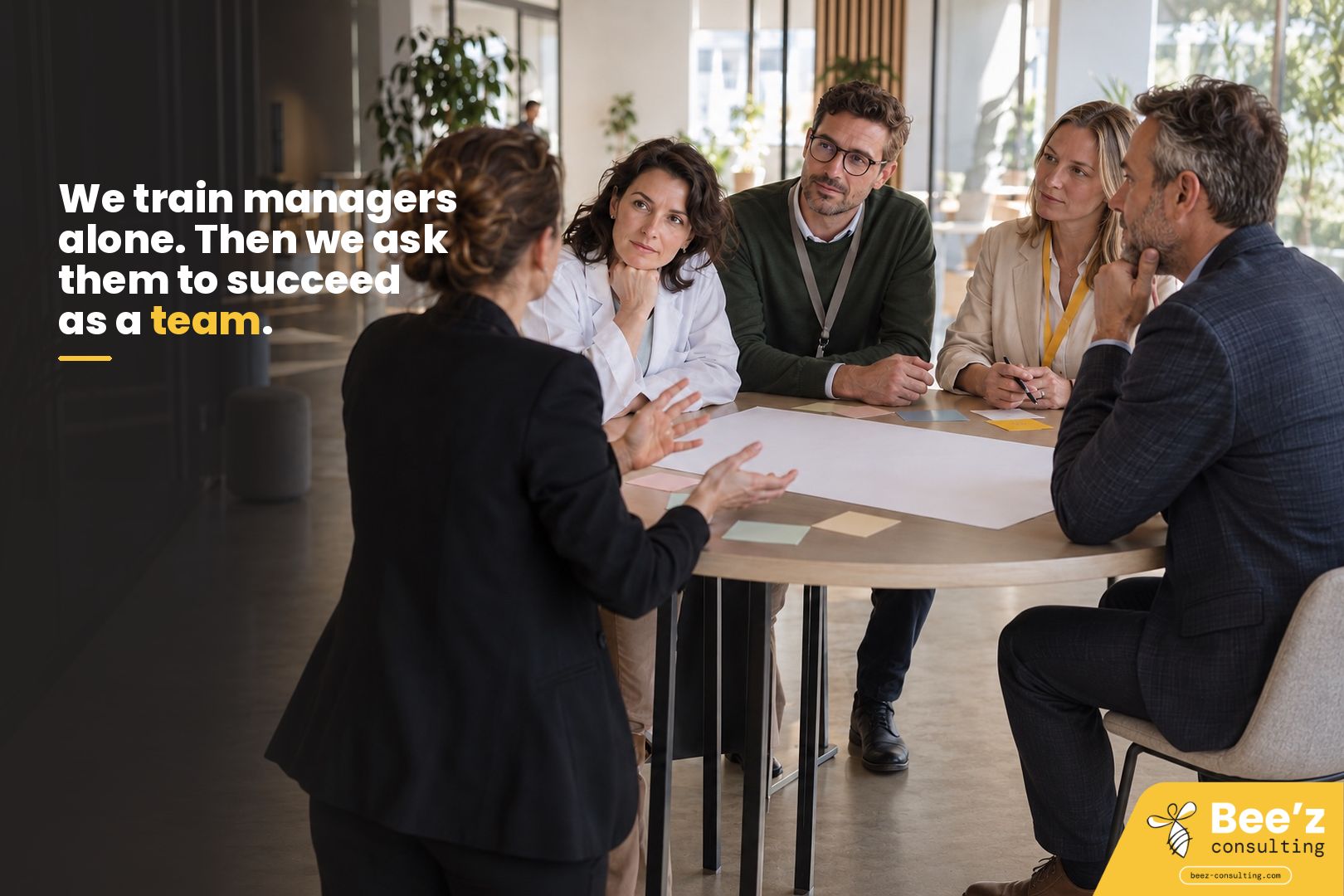
We train managers alone, then ask them to succeed as a team. What clinical simulation teaches management training, in every sector.
When development, recruitment and performance stop building the capabilities you need, your competency framework may be the cause. Three shifts, one test.
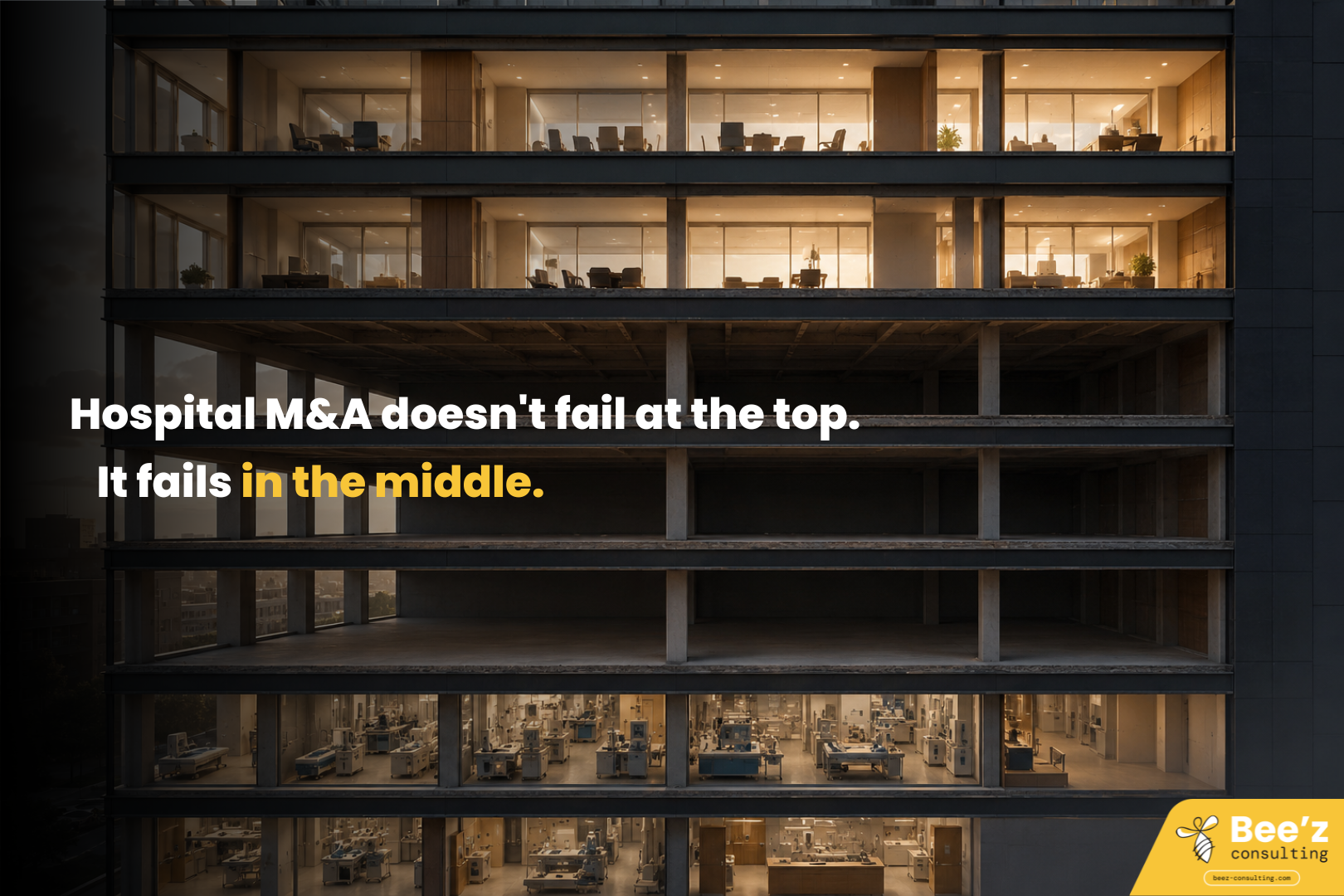
Hospital M&A fails not at the top but in the middle layer. Here is what the governance vacuum looks like and what leaders who see it do differently.

