

This autumn, between sessions at an event, I had a short chat that I cannot forget.
Two leaders. Two very different worlds on paper.
One runs a hospital team. The other leads in the health and life sciences space, closer to products, markets, and scale.
They both said the same thing, in their own words.
“We know what we want to do. But the day to day is heavy. Decisions move slowly. People are tired. And that shows up in the experience.”
Not the strategy. The experience.
The patient experience. The employee experience. The customer and end user experience too.
That one sentence became my “sticky note” for the end of 2025.
Because it explains why so many good plans stall. And why so many smart teams feel stuck.
Over the last months, this came up again and again across the 48th World Hospital Congress in Geneva, the Richmond Healthcare Forum in Davos, the CSPQS Forum on Just Culture in Sierre, FutureHealth in Lausanne, and two CHUV moments, including the symposium “Créer de la valeur en santé par le Value-Based Health Care.” and a public conference on the Dossier Électronique du Patient (DEP).
Different rooms. Same patterns.
So here is a simple post. Not a recap. Not a list of quotes.
A set of shifts.
Things leaders often think they need to fix. And what we keep seeing underneath, across hospitals and clinics, and also across medtech, biotech, pharma, life sciences, and mission-led organisations.
Most organisations do not lack strategy.
They lack clean decisions.
You see it in the middle.
A leadership team aligns. A deck is shared. The next steps are written down. Then the week starts.
Middle managers open their calendars. It is full.
They are asked to deliver outcomes, run operations, manage people, handle change, report up, and keep everyone calm.
And on top of that, they are waiting.
Waiting for a sign-off. Waiting for “the next committee.” Waiting for a choice that should take 30 minutes but takes 30 days.
When decisions sit “in the air,” teams stop moving. Not because they do not care. Because they do not want to do the wrong thing.
Pick the few decisions that are slowing everything down.
Not twenty. Five to seven.
Then make them visible.
This sounds basic. It is. That is why it works.
When decisions flow, pressure drops. Experience improves fast.
Yes, staffing matters. Skills matter. Mix matters.
But in many teams, the bigger issue is load.
Too many priorities. Too many “small” tasks that are not small. Too many extra steps added over time.
If you want a quick test, ask a manager. “What are you expected to stop doing this quarter?”
Silence often follows.
When nothing can be stopped, everything becomes urgent. People cope by cutting corners, staying late, or going quiet.
And that leaks into experience.
Patients feel it in rushed care, longer waits, weaker handovers.
Employees feel it in constant catch-up and that low-grade guilt of never being done.
Customers and end users feel it in delays, friction, and inconsistent follow-through.
Run a monthly “load reset.”
No drama. No long workshop.
A 45-minute routine.
Load is not only about hours. It is also about cognitive load. Switching. Waiting. Chasing.
Lower the noise. You raise performance.
Culture can feel like fog.
Everyone talks about it. Few can point to it.
But culture becomes very concrete the moment something goes wrong.
A near miss.
A complaint.
A mistake.
A tough audit.
A product issue.
A delay.
A safety concern.
What happens next is the culture.
Do we blame. Do we hide. Do we fix. Do we learn.
In 2025, I heard many leaders say they want a stronger culture. More trust. More ownership. More engagement.
Then, in the next sentence, they described a daily reality where people do not speak up early, where feedback is rare, and where hard topics get pushed to “later.”
Culture does not change because we describe it better.
It changes when we practise different behaviours in the moments that matter.
Choose three behaviours. Only three.
Make them visible.
Make them practised.
Make them safe to try.
For example:
Then build tiny routines around them.
Five minutes at the start of a meeting. Two questions at the end. One line in a 1:1.
This is how the hive changes. One small move. Repeated. By many.
Just Culture came up often this year, especially at the CSPQS Forum in Sierre.
The intent is strong. People want fairness. They want learning. They want a safer environment where staff can speak up, and where patients are protected.
But there is a common misunderstanding.
Some hear Just Culture and think it means “no blame,” which can slide into “no accountability.”
Others hear it and think it is a softer way to discipline, which can slide into fear and silence.
Neither works.
Just Culture is a balance.
It says, human error happens. Systems shape behaviour. And people are still responsible for choices.
It also says, we respond in a fair way. Not based on who you are. Based on what happened and why.
Build a shared “response map.”
Not a long policy. A one-page guide.
Most models use three buckets:
The key is not the labels. The key is shared agreement.
When teams know what will happen if they speak up, they speak up sooner.
And that improves experience for everyone.
At CHUV, the symposium “Créer de la valeur en santé par le Value-Based Health Care.” was a good reminder of something simple.
Measures do not change care. Teams do.
Outcomes and PROMs make sense. Many leaders are on board.
The pain is in the “how.”
Where does the data live.
Who owns it.
Who has time to review it.
What happens when the numbers are uncomfortable.
Who gets to decide what to change.
If those questions are not clear, measures stay in slides. People stop looking. Or they look, then shrug, because nothing follows.
Start smaller than you want to.
Pick one pathway. One patient group. One service line. One product journey. One customer segment.
Pick three measures.
Then assign two owners:
Set a rhythm. Monthly is often enough to start.
Review. Learn. Adjust. Repeat.
That is how “value” becomes real. Not by making more dashboards. By making the loop alive.
The public conference on the DEP at CHUV surfaced a very human set of questions.
Who can see my data. When. For what purpose.
What happens if something is wrong.
What is the patient’s role. What is the clinician’s role.
How do we avoid adding extra work.
These are not “IT questions.” They are trust questions.
And trust is built through clarity.
Clarity on roles. On rules. On expectations. On what “good use” looks like.
In every sector we work with, the story is similar.
The tool is rarely the blocker. The day-to-day use is.
When digital adds friction, experience drops fast. People create workarounds. Data quality falls. Confidence falls with it.
Design the “minimum reliable process.”
Ask:
Then pilot. Fix. Scale.
Digital only works when it fits real work.
AI was everywhere in 2025. Talks, tools, demos, hope, fear.
Here is what felt true across many conversations.
AI is not the main story. Change is.
If teams do not trust decisions, they will not trust AI outputs.
If data is messy, AI will reflect that.
If roles are unclear, AI will create new confusion.
If workload is already too high, new tools feel like another task, not help.
So the winning question is not “Which AI tool should we buy.”
It is, “Where do we have a real pain, a clear owner, and the ability to change the work.”
Use a simple filter before any AI move:
If the answer is no, pause. Save time and trust.
If you read all of this and think, “This is obvious,” good.
It is not meant to be clever.
It is meant to be useful.
Because in 2025, the most painful issues were rarely about lack of ideas.
They were about friction in the system.
Decision friction. Load friction. Trust friction. Role friction.
And experience is where that friction shows up first.
Patients feel it.
Employees feel it.
Customers and end users feel it.
And leaders feel it too, often at 10pm, when they are still answering messages that should not exist.
Our focus will stay practical, across hospitals and clinics, and also across medtech, biotech, pharma, life sciences, and mission-led organisations.
Three priorities:
And we are also bringing more voices into the work.
In 2026, in partnership with H2X, we will launch a podcast called À L’Unisson.
The aim is simple. Give space to real stories of care, work, and lived experience, across health and life sciences settings.
Not stories to make us feel good for five minutes.
Stories that help leaders and teams see what changes experience on the ground, and what to do next week.
If you want one question to carry into January, here it is:
What is one decision, one habit, or one rule we could change in the next 30 days that would make life easier for teams, and care or service better for people.
Small moves. Repeated. By many.
That is how real change happens.
.png)


We train managers alone, then ask them to succeed as a team. What clinical simulation teaches management training, in every sector.
When development, recruitment and performance stop building the capabilities you need, your competency framework may be the cause. Three shifts, one test.
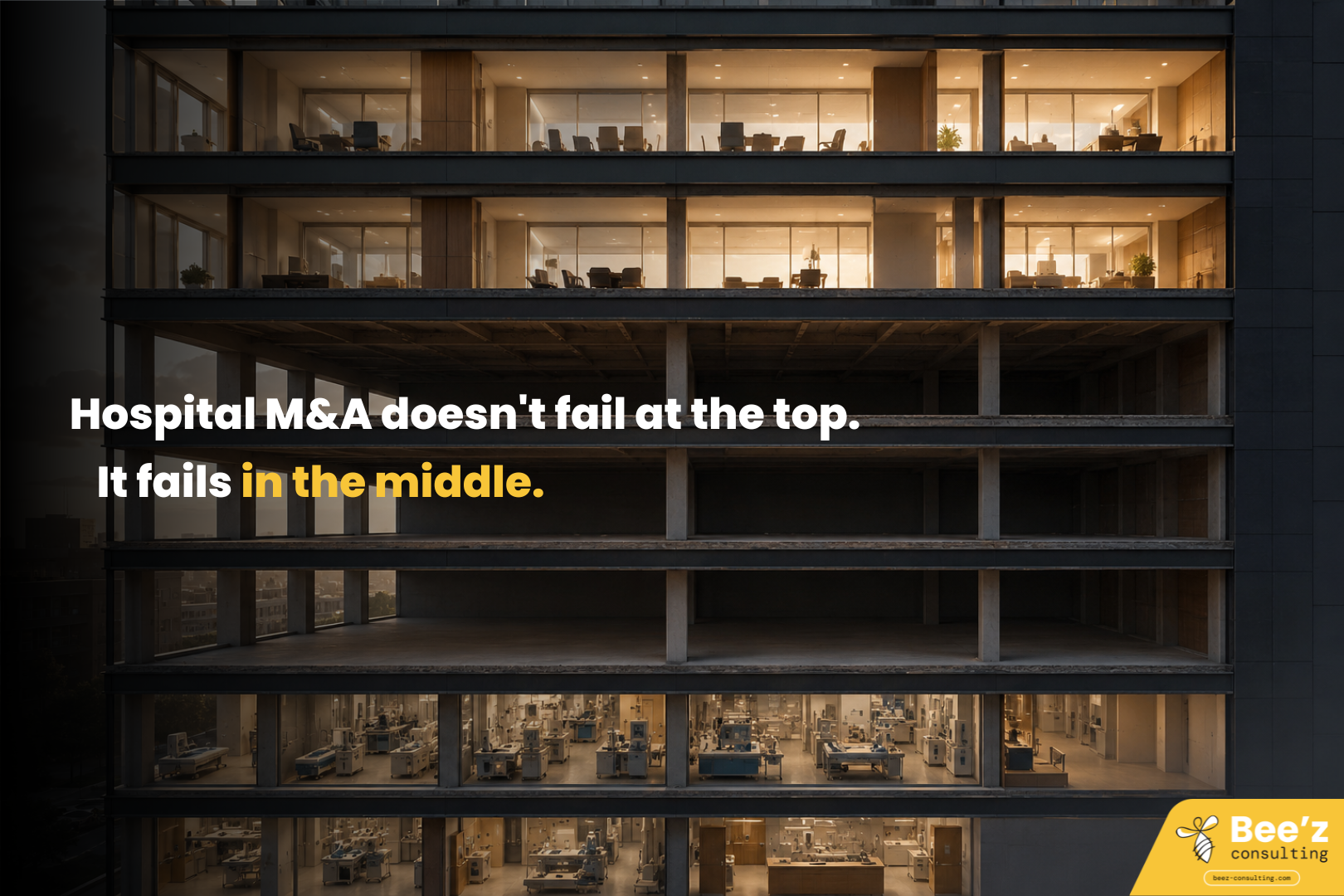
Hospital M&A fails not at the top but in the middle layer. Here is what the governance vacuum looks like and what leaders who see it do differently.

