
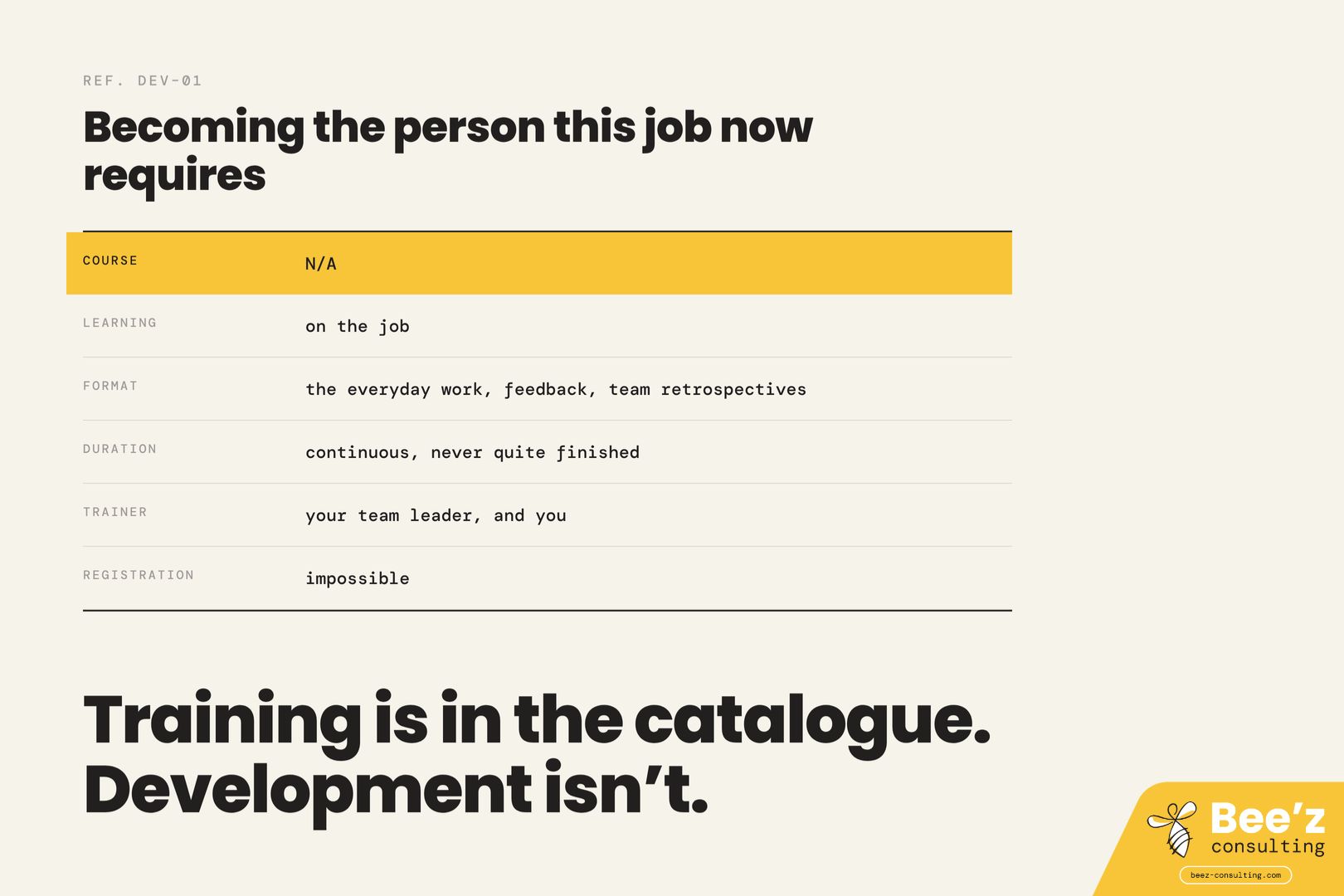
Development isn't decided once a year.
A development conversation is built between a person and their manager, and then picked up again: what good work means now, what they already do well, and what they need to change.
Training is one input.
It is not the mechanism.
In March, a medtech company rolled out a new system for logging field interventions.
Paul's team got a day of training, then went back on the road.
They talked about it. In team meetings, between jobs: the new system, what it changed, what still didn't work.
What never happened was the other conversation.
The one each person would have had with Paul, one to one, about where their own way of working no longer held and what they needed to change.
Six months later, Paul had two excellent specialists in two different jobs.
When a change arrives and nobody sits down to say what good work now means, the decision does not disappear. It moves.
Each person reads the change alone, from the only evidence they have, which is their own work.
They settle three things on their own.
- What to do more often.
- What to drop.
- What deserves the time.
And each of them is right, from where they stand. That is what makes it hard to see.
Nobody is making a bad decision.
Nobody is neglecting anything.
The readings are simply different, and they never meet.
Within months, those readings became habits.
Christian kept settling things by phone and logging the essentials at the end of the day.
Stéphanie did the opposite, documenting each job as she went and reusing her own notes from site to site.
And the habits built real capability.
Christian now reads a situation on site better than anyone.
Stéphanie sees the same faults coming back before the rest of the team.
Nobody chose which ones.
A team that does not align does not stand still. It moves, in as many directions as it has people.
Three people can open a development conversation.
Each of them has the standing to do it.
- The team leader.
- His own manager.
- The person themselves.
None of them owns it.
That sounds like freedom. In practice it is nobody's job, and the conversation slips without anyone being at fault.
The first obstacle is the familiar one.
A team leader has a rollout to hold, clients waiting, and six people whose urgent problems he sees first.
The conversation gets postponed, and the postponement costs nothing visible.
It is always justified.
That is what makes it repeat.
Lack of time is also the obstacle people declare first.
In the Swiss canton of Geneva, a 2021 survey of working people found that among those who could not train as they wanted, 41 percent named lack of time first.
A survey collects what people declare. The other obstacle never gets declared.
For Christian and Stéphanie the question is not whether there is time.
It is whether the request will land well, and whether it is theirs to make.
Saying “I'm no longer sure what's expected of me” can read as an admission of weakness.
Asking to develop a capability can read as a request for budget.
Either way, you take a risk for something that was not on the agenda.
So people wait for the official occasion.
It comes at the end of the year, it looks back at the year, and it already has another purpose.
Nobody is wrong not to open it. That is exactly why it doesn't happen.
Nothing triggers it. That is all it takes for it never to happen.
A development conversation produces three things, and the first conditions the other two.
In this order.
- A shared definition of what good work means in this job, now.
- What the person already does well.
- Where they can improve.
The order is not negotiable. The third does not read if the second has not been said.
The definition is not about volume or deadlines.
It is about what a person has to be able to do, which changes more often than the written reference does.
Take a medical laboratory that has automated part of its lines.
Good work used to mean running series without error.
Now the machine runs the series.
Good work means spotting the result that does not fit, the one the analyser does not flag, and being able to say why it looks wrong.
Nobody can produce that definition alone.
The manager brings what the organisation now expects.
The person brings where the work resists.
The definition comes out of both.
It is weak if only one side sets it.
In many hospitals and clinics there are no individual yearly objectives at all. There is a strategy.
The middle layer is expected to make it usable.
The team leader is the only one who can turn an institutional direction into what it asks of one person, in one job, this year.
We ran that work in a private clinic in French-speaking Switzerland, after a governance change that altered what was expected of the middle managers.
Leadership and all the middle managers first went back over the strategy together, and over what the function now required.
A simulation let them try the conversation before holding it.
Then they worked in subgroups to turn the strategy into annual objectives, which each of them took back to their team.
Two things came out of it.
The managers felt ready to hold the conversation with their teams, on individual objectives as well as the department's.
And it was the first time the discussion ran both ways.
Leadership said what it expected, the middle managers said what they saw on the ground, and the annual objectives were set with them rather than for them.
The next step is one level down. From the department to the person.
Until that translation is made, each person makes it for themselves.
When a development point is named, the reflex is to look for where to train.
The catalogue comes out, the person gets booked, the subject closes.
Yet a development point that has been understood does not need a course first.
It needs the person to know, for the months that follow, what they are trying to do differently.
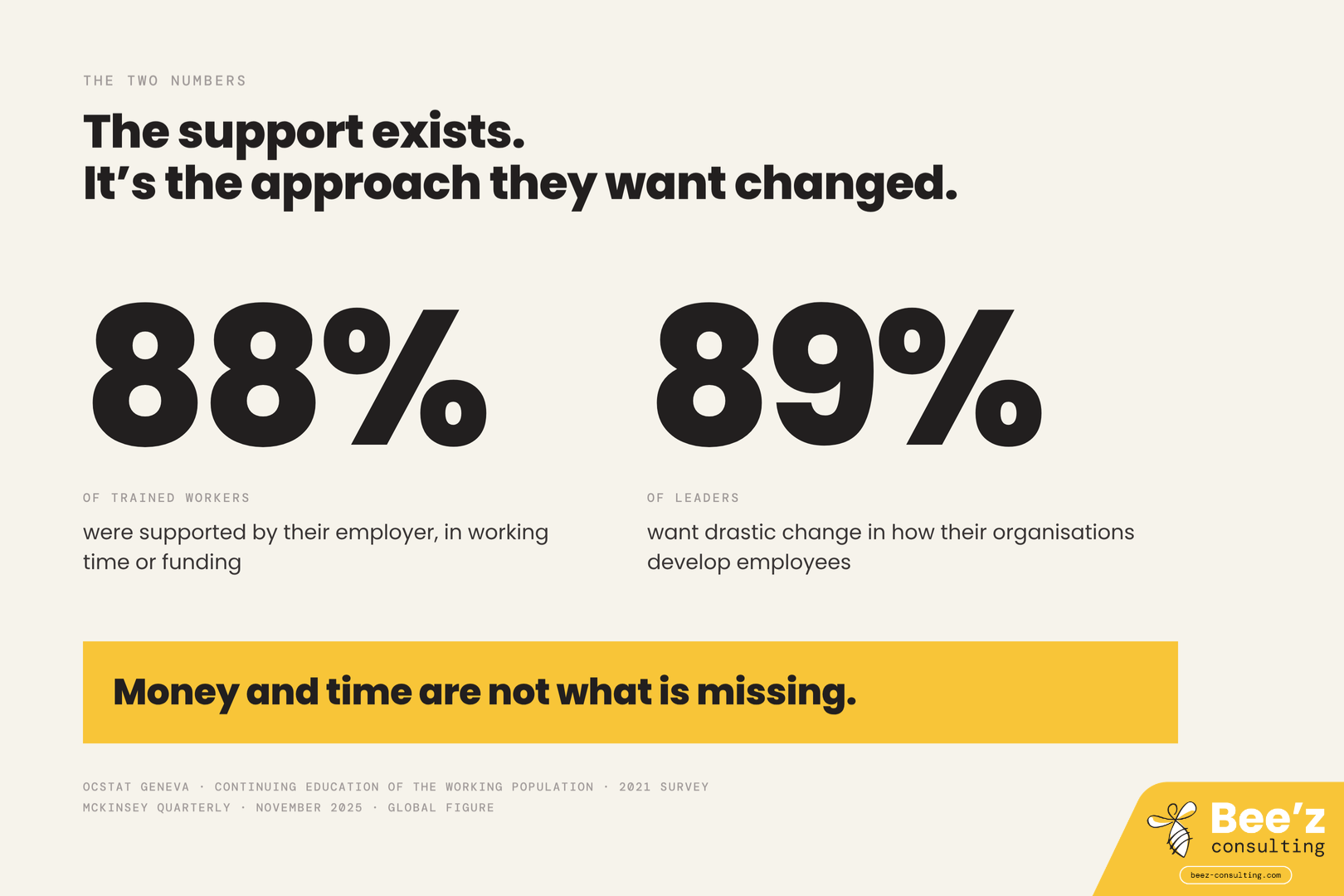
Money and time are not what is missing.
In the Swiss canton of Geneva, among working people who took job-related training in 2021, 88 percent had support from their employer, in working time or in funding.
In a November 2025 article, McKinsey puts at 89 percent the share of leaders looking for drastic change in how their organisations develop employees.
They are not asking for a better catalogue.
They are asking for a different approach.
Christian now knows his strength is reading a situation on site, and his weak point is leaving a trace other people can use.
He does not need a module on technical documentation.
He needs that trace to become, for a few weeks, the thing he watches in his own work.
What will move him is the everyday work, once he knows what he is trying to do differently.
And the person does not wait to be told.
Christian can come to Paul with his own reading: what he thinks he does well, what he still finds hard, what he would like to try.
Then ask for feedback on it.
That is usually where the conversation becomes useful, because it starts from what the person has already seen in themselves.
Training keeps its place in the mix, and it is one element in it.
It does little when someone is sent on their own, away from the team that will have to apply it.
The rest is written down nowhere.
- What the person lives through at work.
- The feedback they get.
- The time they take to look at how they work.
- Team retrospectives.
- Looking hard at what went wrong.
A simulation lets that examination happen before it counts.
The team leader holds a part of it, as a coach.
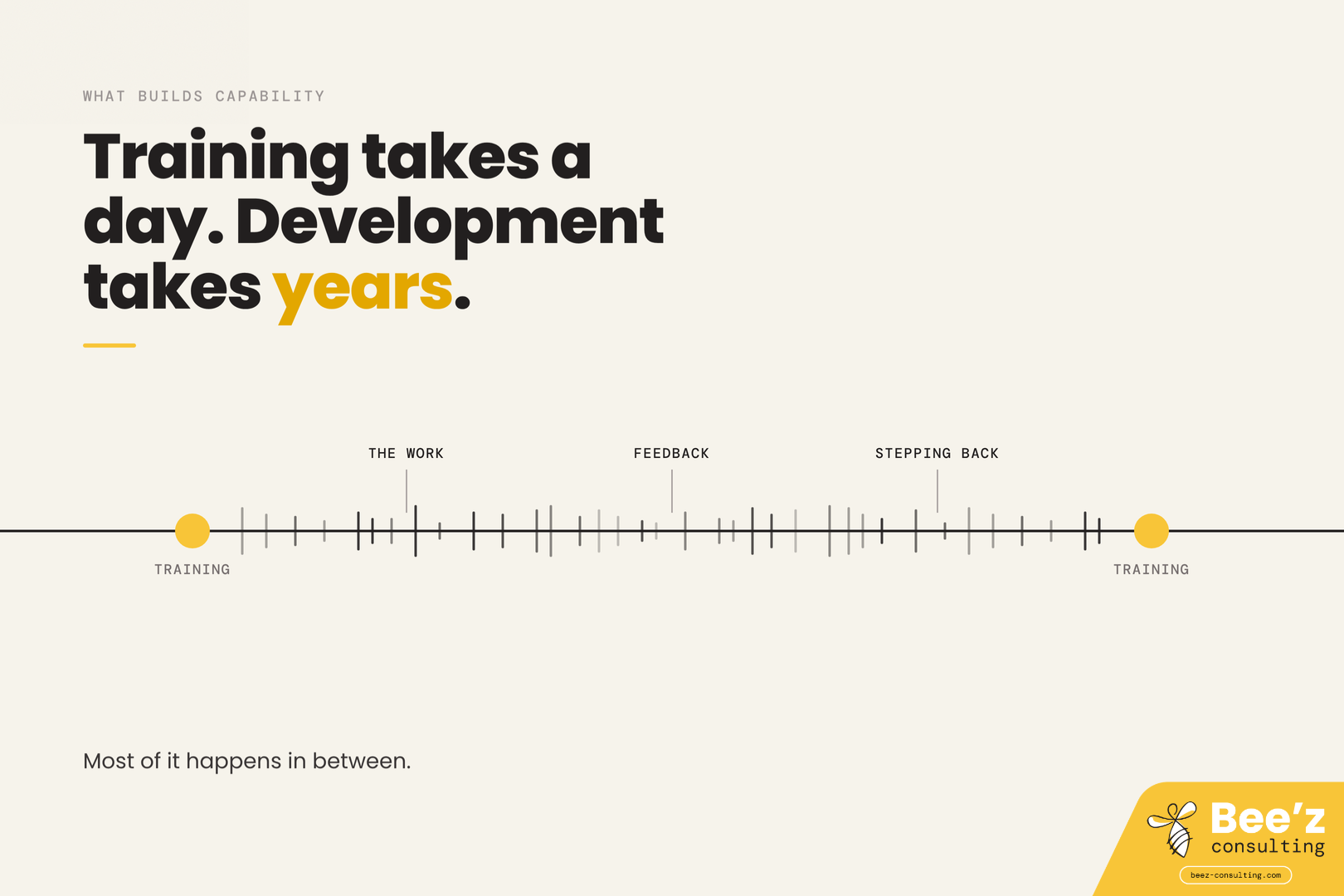
Everyone has talent, and it needs the same care in everyone.
The destination is a shared idea of what excellence looks like in that job, and of the route to it.
It gets built slowly, not in three days in a room.
Capability is not built in one course and one discussion with a manager.
It gets built another way.
- Through continuity.
- Through what gets passed on between people in the team.
- Through taking on responsibilities nobody had before.
Over two years, over three, and never quite finished.
At the Fondation Asile des aveugles, Ingrid Vernez describes a competency plan set at three, five and ten years, with a gap analysis repeated every year.
The format matters less than what it assumes: the horizon is longer than one exercise, and it gets revisited.
None of this is decided once. You come back to it.
You look at what has moved since the last time, what has held, what no longer does.
You don't develop someone with a plan decided once. You do it with a conversation picked up again over several years.
In six months another change will arrive in Paul's team.
There will be a new way of working, and the team will adapt.
The only question is whether this time he sits down with each of them.
If you only change one thing: before the next review cycle, book one hour per person and open it with what good work means in their job now, not with last year's results.
If this sounds like your own team, describe the situation to us.
At least once a year, and every time the work genuinely changes: a new system, a reorganisation, a new type of patient or client. The change is the real trigger, not the calendar. An organisation that waits for the annual date loses all the time between the change and that date, and during it the person decides alone what now counts in their job.
An annual review looks back at the year and records what was done. A development conversation looks at what the job requires now and what the person will change next. The order matters: the annual review comes first, because what was not done, or what needs deepening, shows where development is needed. And the benefit is not only individual. This is how a team's capability keeps pace with how fast the work changes.
Capability that keeps pace with how fast the work changes. Artificial intelligence and the rhythm of reorganisations have shortened the gap between the moment a job transforms and the moment the team has to work differently. Without these conversations each person progresses in their own direction, and the organisation ends up no longer knowing what capability it actually has.
Either can open it, and the manager's own superior can also ask for it. That is precisely the problem: when three people can do it, none of them owns it, and the conversation gets postponed without anyone being at fault. The simplest way to make it real is to write it into what is expected of the team leader.
This is the situation in many hospitals and clinics: there are no individual objectives, there is a strategy. The middle layer is then expected to turn it into what it asks of one particular person, in their job, this year. Without that translation each person does it for themselves, and the team moves in separate directions.
Not first. A development point is understood first, meaning the person knows precisely what they are trying to do differently. The means is chosen after that, and the means is often the everyday work rather than a module. Training keeps its place in the mix, alongside the feedback people get, the time they take to look at how they work, and team retrospectives.
Nobody can do it alone. The manager brings what the organisation now expects, the person brings what they see of the real work and of where the old ways no longer hold. The definition comes out of both of them, and it is weak if only one side sets it.
The reason is rarely lack of time. Many wonder whether the request will land well, and whether it is theirs to make. Saying you are no longer sure what is expected of you can read as an admission of weakness. Saying once, explicitly, that the question is expected and will not be read that way changes the situation.
By keeping the order. First a shared definition of what good work means now, then what the person already does well, then only where they can improve. The third does not read if the second has not been said. And the subject of the conversation stays what is coming, not a score on what has passed.
Everyone. It is not about identifying a separate category and reserving the attention for it, but about giving each person the same care on what they do well and on what they can change. Capability is not built in one course and one discussion. It is built through continuity, the everyday work and the feedback people get, over two years or three.
Read next: why healthcare transformation stalls in the clinical middle.


Development isn't decided once a year. What a development conversation contains, why it so rarely happens, and what actually builds capability at work.
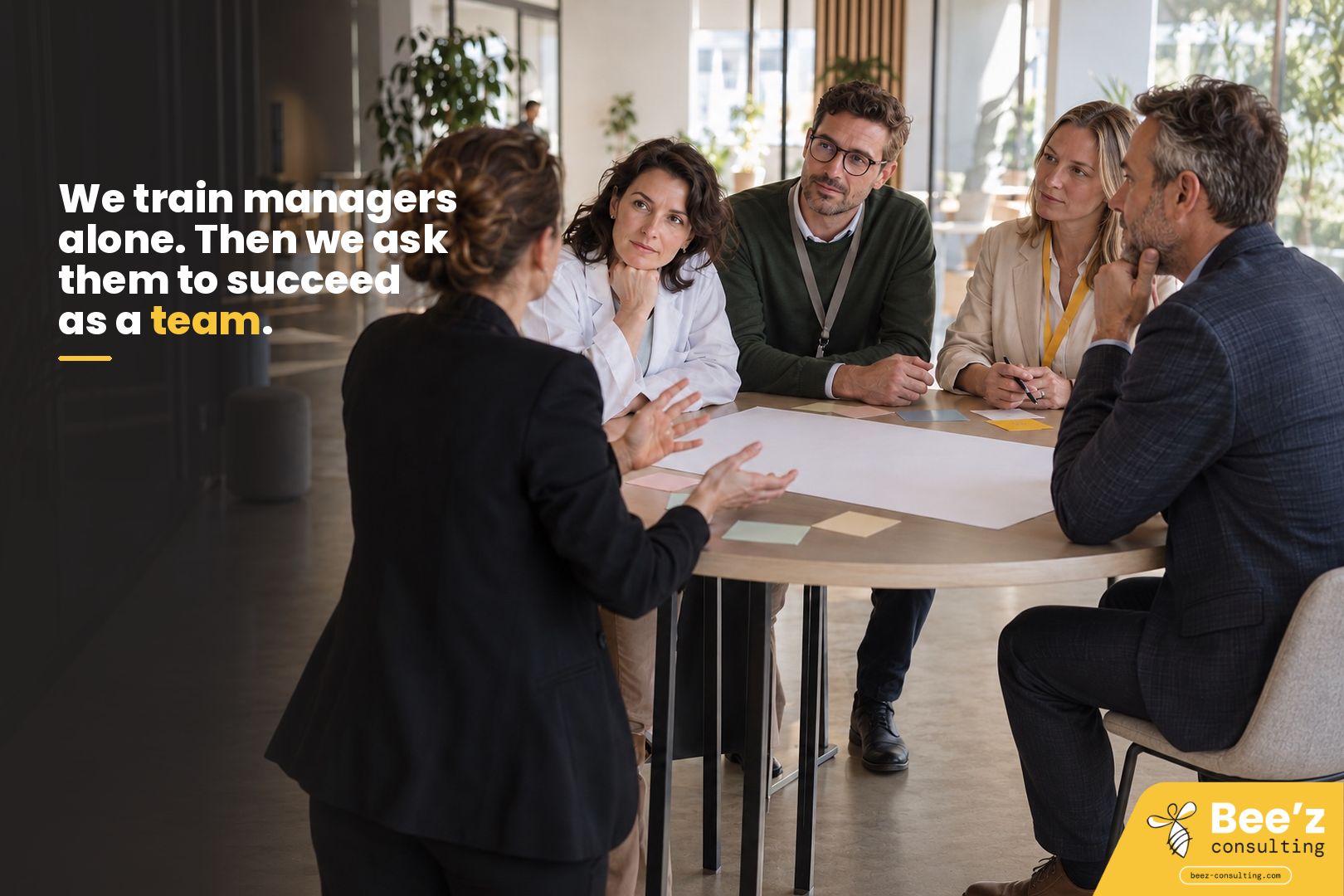
We train managers alone, then ask them to succeed as a team. What clinical simulation teaches management training, in every sector.
When development, recruitment and performance stop building the capabilities you need, your competency framework may be the cause. Three shifts, one test.

