

A nurse in Geneva told us recently, “We’re back to ‘normal’—but no one feels normal.”
Appointments resumed. Checklists were dusted off. KPIs returned.
But under the surface? Fatigue. Cynicism. A quiet fear of going back to the way things were.
Because in too many hospitals, “recovery” meant restoring compliance, not rebuilding trust.
It meant ticking boxes, not listening to the people behind them. And that’s the danger.
When the system survives, but the spirit doesn’t.
In Europe, Switzerland, and the Middle East, hospitals are among the best-resourced and most technically advanced in the world.
They proudly display their accreditations:
But let’s say it plainly: Compliance is not transformation.
It ensures minimum standards.
It avoids legal risk. It’s necessary. But it’s not sufficient.
Because while policies may be aligned… Behaviors often aren’t.
Teams nod in meetings—but don’t speak up in practice.
Processes are defined—but never refined.
Excellence doesn’t come from meeting the standard.
It comes from questioning it. Together. Every day.
Hospitals that outperform don’t just implement systems. They build habits.
They don’t just train teams. They involve them.
They don’t just measure errors. They learn from them—fast, together, openly.
Take international quality frameworks like:
Yes, they raise the bar.
But the real magic isn’t the framework. It’s how a hospital chooses to engage with it:
Those results didn’t come from theory. They came from culture in motion.
Most hospitals still approach transformation like this:
Because when improvement is imposed, it rarely becomes real.
People may agree. But they don’t own it.
"It felt like they redesigned the patient journey—but forgot we were in it,” a nurse manager in Lisbon told us.
Real change doesn’t come from PowerPoint slides.
It comes from shared ownership. From collaboration before communication.
Co-development means no more “us and them.”
It means: You built this. You believe in this. You’re responsible for this.
And it works—because it brings hidden insights to the surface.
Here’s what it looks like:
At Bee’z, we’ve seen hospitals increase staff retention, reduce errors, and re-ignite engagement—simply by letting the right people into the room earlier.
Not for input. For ownership.
Transformation doesn’t fail because people resist change. It fails because people weren’t invited to shape it.
Behavior change is the real unit of transformation.
Everything else—strategy, frameworks, communication—is scaffolding.
If you don’t address behavior, nothing sticks.
If you do? Everything can shift.
But behavior doesn’t change through pressure. It changes through practice, presence, and psychological safety.
A major Middle Eastern clinic approached Bee’z with a challenge:
- High turnover, high variability in patient experience, and a sense that “we’re surviving, not improving.”
Here’s what we did together, through our Profit4Health framework:
This isn’t theory. It’s what happens when people believe change includes them.
Too many hospitals treat improvement like a project. Or worse—a compliance function.
But the ones that lead the future? They treat it like breathing.
Every team. Every week. Every role. Not once a year in the strategy review.
They turn "good enough" into "what else could we do together?" And that’s where excellence is born—not from pressure, but from participation.
If you're still approaching change as a compliance requirement—
If you're hoping the next tech platform will fix your workflows—
If you're tired of good ideas dying in committees—
Then this is your invitation to do it differently.
Not harder. Not louder. Just… together.
Because continuous improvement doesn’t live in reports. It lives in behavior.
It lives in every conversation you’re not having yet.
In every idea a nurse hasn’t shared.
In every meeting where people stay silent—because they think it won’t matter.
Let’s make it matter.
Ready to move from compliance to co-creation?
From exhausted to aligned?
From “what now?” to “what next?”
We’re ready to walk beside you.
💡 Learn more: Bee'z Consulting - Profit4Health
📩 Or book a call to explore your specific challenges:s: Contact Bee'z Consulting
🔹 Why should European and Swiss hospitals look beyond national standards?
Because global best practices can elevate patient outcomes, streamline operations, and create a unique positioning in the market—ensuring your hospital stands out.
🔹 What’s the difference between compliance and continuous improvement?
Compliance ensures you meet minimum requirements. Continuous improvement ensures you exceed expectations and stay ahead of future challenges.
🔹 Why is co-development essential in hospitals?
Because top-down mandates often fail. The best ideas for improvement come from those on the frontlines of care—doctors, nurses, and administrators.
🔹 What is Profit4Health?
It’s Bee’z Consulting’s proprietary framework designed to help hospitals implement continuous improvement and co-development strategies for long-term success.
🔹 How can my hospital get started?
Reach out to us today for a strategy session: Contact Bee'z Consulting
.png)


We train managers alone, then ask them to succeed as a team. What clinical simulation teaches management training, in every sector.
When development, recruitment and performance stop building the capabilities you need, your competency framework may be the cause. Three shifts, one test.
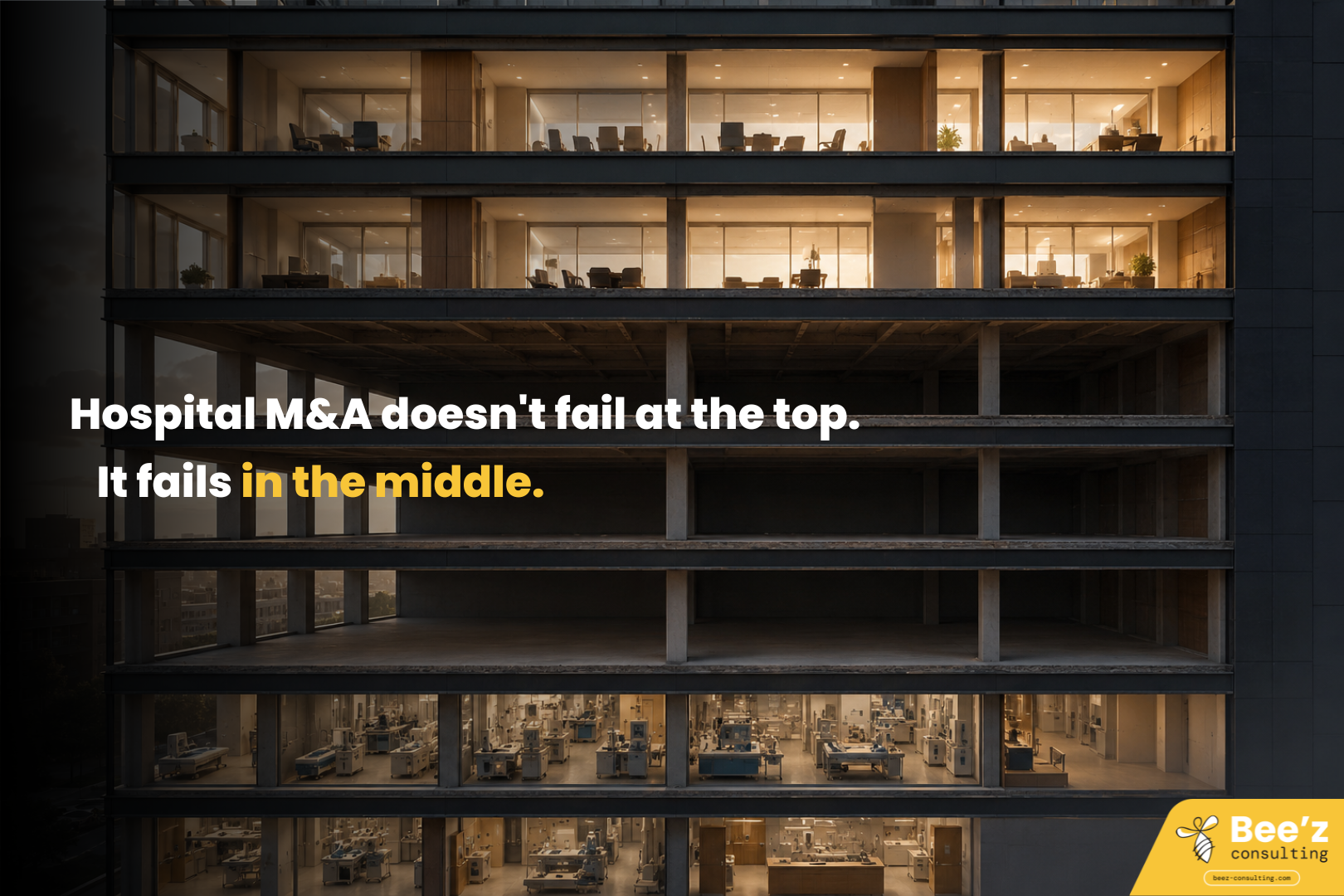
Hospital M&A fails not at the top but in the middle layer. Here is what the governance vacuum looks like and what leaders who see it do differently.

