

In times of crisis and change, leaders double down on strategy.
They redesign business models. Launch transformation plans. Cut costs. Realign priorities.
But there’s one thing they often underestimate — or ignore entirely:
Culture.
And yet, culture is what determines whether a strategy will soar...
or sink in silence.
At its core, strategy is logical. It defines goals, aligns resources, sets the path forward.
Culture, on the other hand, is emotional.
It translates strategic intent into shared norms, habits, and beliefs. It guides what people say “yes” to — and what they silently reject.
Cultural norms are invisible traffic signs inside organizations.
They signal what’s encouraged, tolerated, discouraged… or punished.
A brilliant strategy, executed within a culture that resists it, will stall — or worse, fail.
In a fast-changing world, only agile organizations will thrive.
And agility isn’t just about tech or processes.
It’s about people’s mindsets.
As Gartner analyst Aashish Gupta puts it:
“Employees trapped in a fixed mindset can slow down — or worse, derail — a company’s transformation initiatives.”
And he’s right.
Because transformation doesn’t just require new tools.
It requires new ways of thinking.

Between 2000 and 2014, Microsoft stagnated.
Its growth plateaued. Innovation slowed. The company lost its spark.
Then in 2014, something changed. Fast.
Enter Satya Nadella.
As CEO, Nadella quickly identified the root issue:
Not product. Not strategy. Culture.
Microsoft was stuck in a fixed mindset.
Failure was feared. Risk-taking was avoided.
Employees didn’t experiment — they protected their status.
Nadella made it his mission to shift the entire company towards a growth mindset.
But he didn’t just tell people to change.
He and his leadership team embedded the mindset into:
The results? Unambiguous.
📊 Microsoft’s stock price soared from $45 to over $185 before COVID-19 hit.
And more importantly: the company became relevant — and innovative — again.
So the question is not: “Do we need to change our culture?”
The question is: “What kind of culture do we need to win now?”
And: Are we brave enough to build it?
Here are a few prompts for your leadership team:
We know you need to stay productive, competitive, and keep your people engaged.
We’re experts in cultural transformation and change management — especially in healthcare, life sciences, and mission-driven sectors.
We help leaders:
📞 Contact Bee’z Consulting today.
Let’s talk about what it would take to turn your culture into your greatest lever for post-crisis growth.
Bee’z Consulting — Bold Change. Powered by People.
.png)

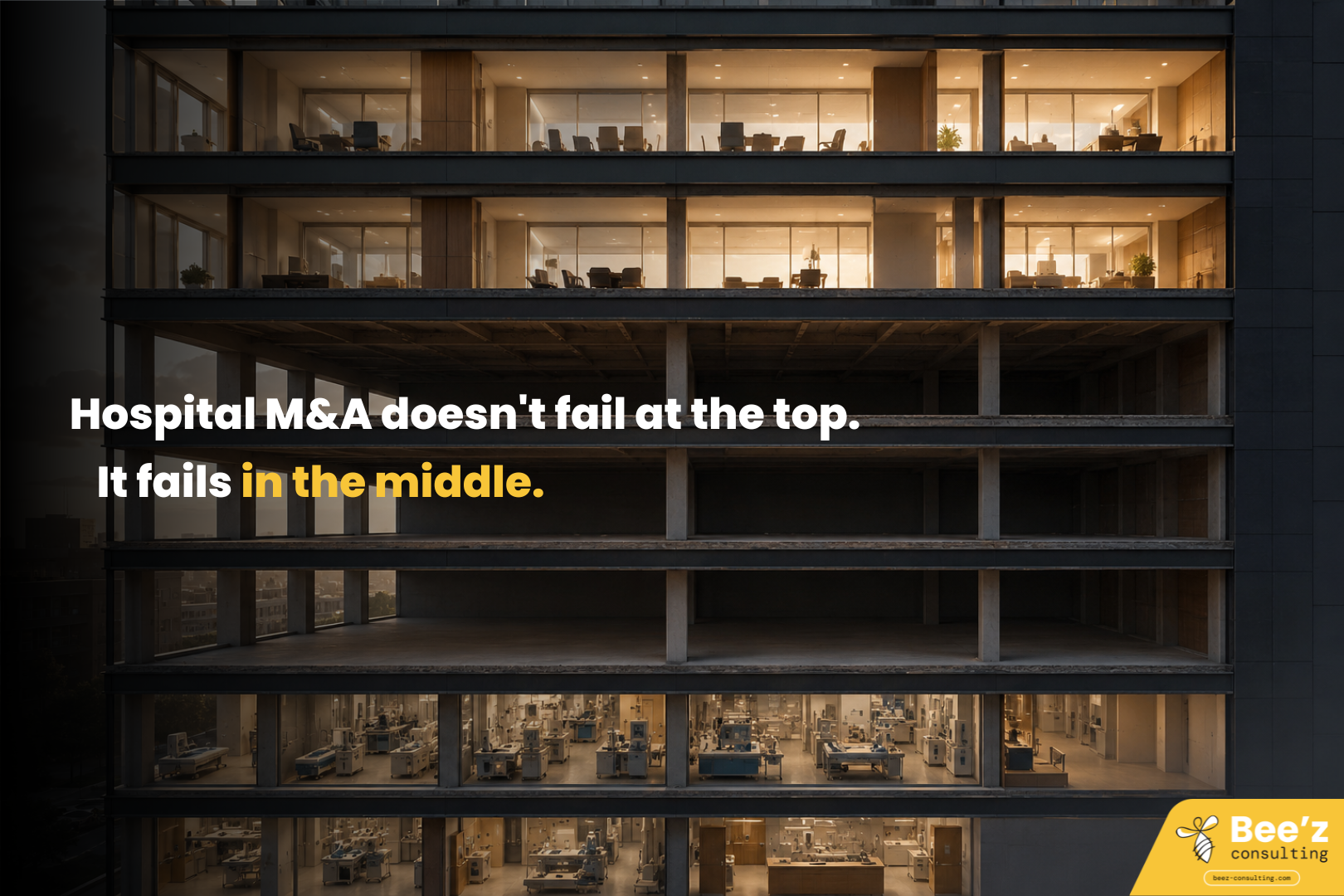
Hospital M&A fails not at the top but in the middle layer. Here is what the governance vacuum looks like and what leaders who see it do differently.

Across Europe, care is moving out of hospitals. What will determine whether it works: the operating rules inside networks, and preparing the people who run them. 3 operational keys.

Healthcare handoffs break for three structural reasons. Ownership stops at the door. Authority never travels. The decision was never built to survive.

